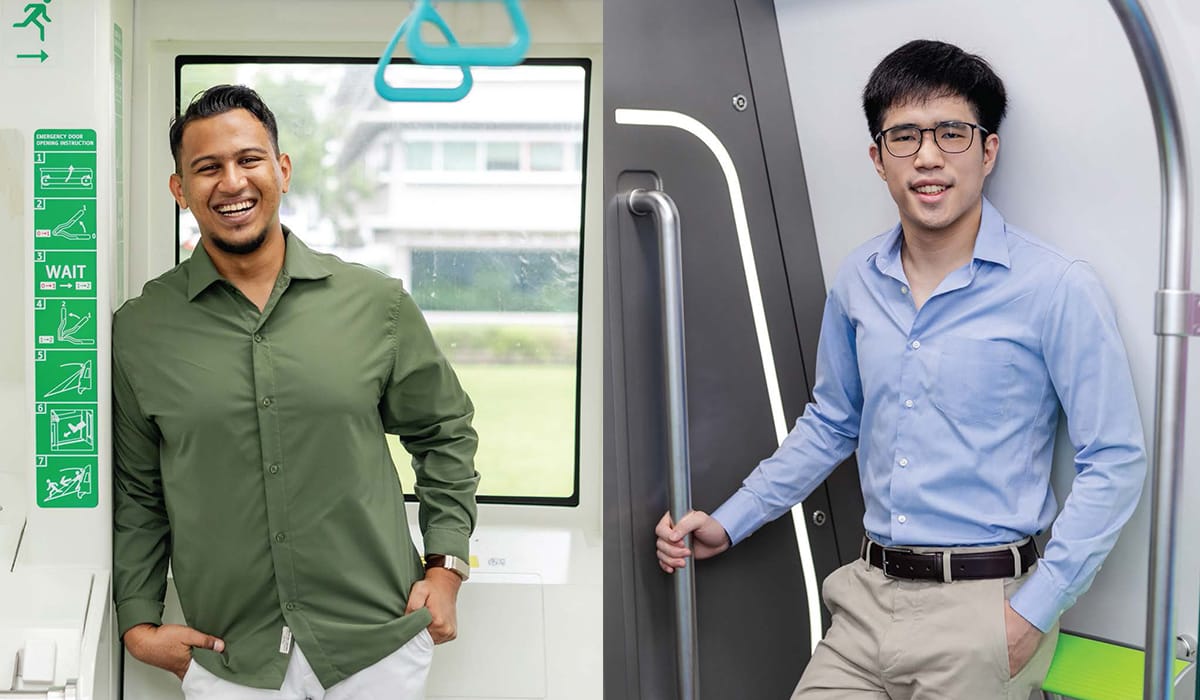
Left: Mohamed Izzat Bin Mohamed Abdul Kadir is an SGRail Industry Scholar and a Mechanical Engineering with a Second Major in Business undergraduate at NTU. He completed his internship at SBS Transit, where he worked on innovative solutions involving rail vehicle maintenance.
Right: Yong Qi An, Caleb is an SGRail Industry Scholar and a Mechanical Engineering undergraduate at NTU. During his internship with SMRT, he gained hands-on experience in both Heavy Maintenance and Rolling Stock Depot, contributing to daily preventive maintenance and fault troubleshooting.
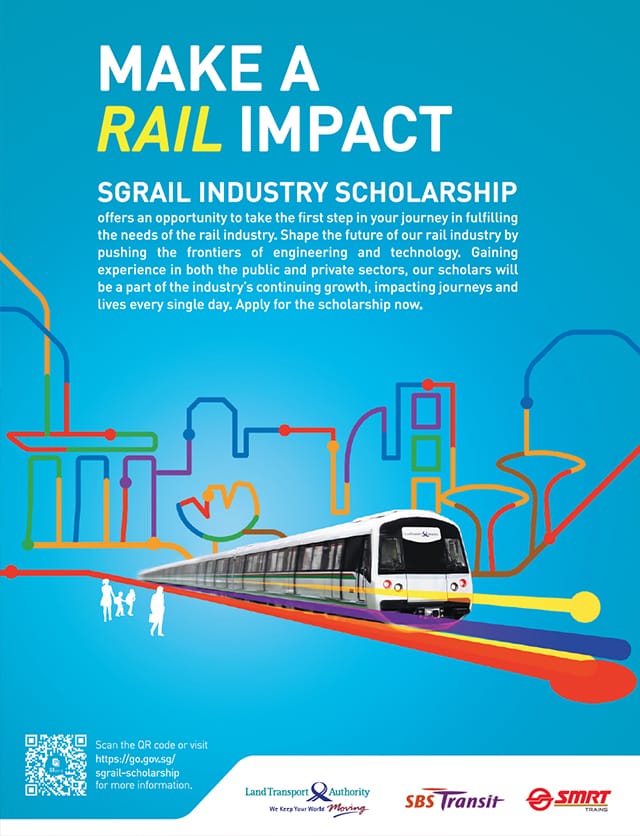
The SGRail Industry Scholarship offers passionate individuals the chance to drive Singapore’s rail industry forward. Through structured developmental training, scholars gain the skills needed to shape the future of rail transportation, with the opportunity to intern at organisations like the Land Transport Authority, SBS Transit, and SMRT Corporation. Scholars get the opportunity to gain experience in key areas such as Signalling, Rolling Stock, Power, and Systems, while working alongside specialists and technical experts to broaden their industry perspectives.
We caught up with SGRail Scholars, Mohamed Izzat Bin Mohamed Abdul Kadir and Caleb Yong Qi An to learn more about their enriching internship experiences. Izzat and Caleb, both currently pursuing their undergraduate studies, share how they’re putting their engineering skills to work, learning from the industry pros, and gearing up to help shape the future of Singapore’s rail system.
What sparked your interest in the rail industry?
Caleb: I saw the integral role that the rail industry plays in Singapore’s transport landscape—directly impacting our daily lives. With sustainability becoming more critical, rail stands out as one of the most eco-friendly ways to travel. I wanted to make an impact on the lives of those around me as well as the broader community.
When I discovered the SGRail Scholarship online, I was highly motivated to apply. I was excited by the chance to be exposed to the diverse world of rail engineering, where I’d get to explore the entire life cycle of the rail system. It was the perfect fit to apply the skills I learnt in my Mechanical Engineering studies to real-world challenges.
Izzat: My interest in the rail industry was sparked by my passion for multi-system automotives. Railways, in particular, are a perfect blend of complex systems—integrating power, control, and safety mechanisms across vast networks. This aligns with my love for vehicles that combine engineering precision with real-world impact.
When I learnt about the SGRail Scholarship at a career fair, I thought it was a perfect fit. Beyond the valuable exposure I would gain in the industry before graduating, the professional development opportunities and growth prospects in the rail sector truly inspired me to pursue the scholarship.
That’s inspiring! Could you give us an overview of your daily tasks during your internship and the challenges you faced?
Caleb: I interned with SMRT in two rotations—Heavy Maintenance (HM) and the Rolling Stock Depot (RSD). In HM, I was involved in overhaul work and assisted engineers in drafting engineering drawings for tools and technical documents. I learnt a lot about the different train components and how they are maintained. In RSD, I was involved in frontline maintenance and daily preventive tasks, where I experienced firsthand the true meaning behind continuous improvement. I was able to observe the introduction of a new method to do inspection, such as utilising a flexible fiberscope to assist in the train inspections. The fiberscope is a flexible instrument with camera lenses on one of the ends and can be used to inspect narrow areas such as the small nooks and crannies of the trains. With the utilisation of the fiberscope, the team can assess and inspect the wheel without having to disassemble the different components. This increased efficiency as it sped up the inspection time greatly. I also shadowed engineers during fault troubleshooting, which helped me understand how sub-components work together. The amount of technical information was challenging at first, but it was also really rewarding. The support from my supervisors and colleagues during the internship made the learning curve much easier.
Izzat: During my internship at SBS Transit, I was actively involved in a range of projects that contributed to both safety and operational improvements. For example, I drafted a Locomotive Monthly Maintenance Work Instruction and installed a temperature sensor in the Rail Grinding Vehicle’s compressor, enabling real-time monitoring to detect anomalies—an essential step for enhancing safety and reliability. Beyond these, I applied my skills in Computer- Aided Design (CAD) software to develop 3D prototypes. While the learning curve was steep at times, the experience allowed me to develop technical expertise and confidence, thanks to the guidance and support of my supervisors.
Before your internships, did you have any misconceptions about the rail industry that changed over time?
Caleb: I had heard that the rail industry was slow to innovate, but my internship at SMRT proved otherwise! I came across multiple projects that utilised cutting-edge technologies, like Artificial Intelligence to monitor train status and computer vision to enhance passenger safety. There are numerous ongoing projects focused on continuously improving operations.
Izzat: A common misconception was that the rail industry is outdated but that couldn’t be further from the truth. During my internship, I worked on innovative projects, including developing a real-time temperature monitoring system using an open-source electronics platform that combines hardware and software.
Rail companies are investing in technology to improve safety, efficiency, and sustainability. It’s exciting to witness how these innovations will shape the future of transportation. I even saw a robot undergoing testing and commissioning for train inspection!
Izzat, what’s one memorable project or experience during your internship that helped you appreciate the rail industry?
One memorable project was assembling the temperature sensor using the open-source electronics platform. It allowed me to learn something entirely new, expanding my skills beyond the traditional scope of mechanical engineering. Even as an intern, I was given the autonomy to work independently on this project, which enabled me to experiment and find the best solutions. The engineers on my team were incredibly supportive and empathetic when I needed help. They consistently provided constructive feedback on my skills, which I continue to apply in my daily tasks.
Caleb, it must feel good seeing your coursework come to life. How did your degree studies prepare you for the work you were doing?
It gave me a good head start, especially when it came to reading, designing, and interpreting engineering drawings which convey information on dimensions and specifications of each tool or component. With the guidance from my supervisor, I was able to utilise computer-aided design software to create an engineering drawing of a spring compressor, a tool essential for compressing springs in the train bogies* during maintenance, enabling their reinstallation after inspection and testing. The engineers are then able to reference the drawings when they reinstall the springs back onto the train bogie during maintenance works. This experience refined my design skills and underscored the importance of this tool in enhancing efficiency and safety.
What advice would you give to students interested in pursuing a career in the rail industry?
Caleb: Always be willing to explore new things. You never know what might spark your interest or be useful down the road!
Izzat: My advice is to be proactive in gaining hands-on experience. It helps reinforce theoretical knowledge and gives you a strong advantage. Embrace teamwork and be ready to collaborate across different engineering disciplines to succeed.
*A train bogie is a structure beneath each train where the axles and wheels are attached.