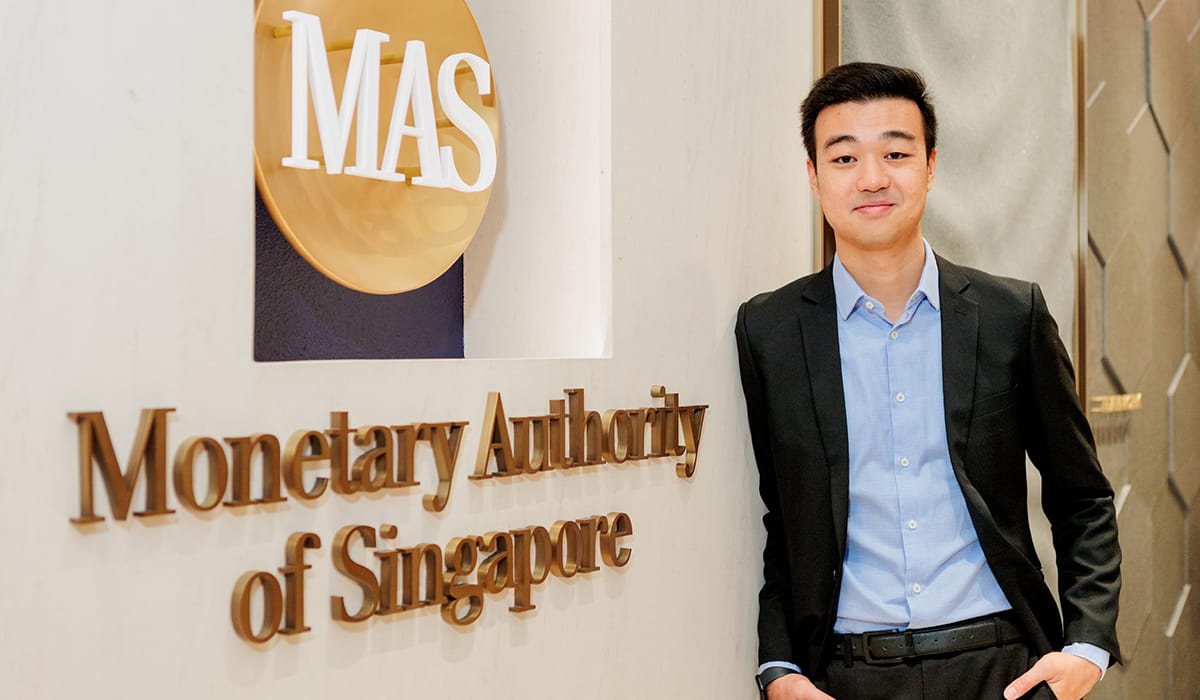
Wei Han is an Economist in the Macroprudential Surveillance Department at the Monetary Authority of Singapore (MAS). He is a recipient of the MAS Undergraduate Scholarship and holds a Bachelor of Science in Economics from the London School of Economics and Political Science and a Master in Finance from Princeton University.
The Monetary Authority of Singapore (MAS) plays a crucial role as the country’s central bank, financial regulator, and developer of the financial sector. For those with a keen interest in public service and the financial sector, MAS offers a unique career proposition—the opportunity to shape the future of finance, promote financial stability and innovation, while greening the financial system.
Wei Han, an Economist in MAS’ Macroprudential Surveillance Department, was drawn to this prospect. His journey began in junior college, where he developed an initial interest in economics. After graduation, he delved deeper into the subject, with his interest piqued by the Global Financial Crisis of 2008–2009.
“I was intrigued, especially by the pivotal role of central banks in defusing the crisis,” Wei Han recalled. “I developed an interest in understanding the global economic and financial system, the interactions between them, and the impact they bring to the daily lives of the ordinary citizens.”
Recognising MAS’ key role in ensuring Singapore’s economic and financial stability, coupled with his desire to work in public service, Wei Han saw the organisation as aligned to his intellectual interests, and an ideal place to build his career.
Investing in Potential
MAS awarded Wei Han its Undergraduate Scholarship, sponsoring his Bachelor of Science in Economics at the London School of Economics and Political Science (LSE), and Master in Finance at Princeton University.
At both institutions, Wei Han had the privilege of learning from individuals at the forefront of research and practice in their respective fields. For example, “I managed to take a class on the political economy of central banking from Alan Blinder, who was formerly the Deputy Governor of the US Federal Reserve and a renowned economist,” he shared. “I learned fascinating insights into the internal decision- making processes of the Federal Reserve.”
Wei Han’s academic journey was marked by active engagement with a diverse group of experts and peers. At LSE, he joined the university’s Economic Society, which enabled him to learn from prominent individuals across government, academia, and the financial industry. In his final year, inspired by his experiences, he formed a students’ society dedicated to central banking, focusing on topics such as monetary policy and financial stability.
-->Real-World Experience
Summer breaks provided Wei Han with valuable internship experiences at MAS. In the Fintech and Innovation Group, he gained first-hand exposure to Singapore’s exciting fintech scene and MAS’ role in fostering a vibrant fintech ecosystem. Later, in the Financial Risk Specialist Division under the Banking Department, he worked on enhancing and streamlining risk surveillance conducted by MAS on the financial sector during the Covid-19 pandemic.
“I helped to build a dashboard of risk indicators to monitor and assess the different financial risks faced by financial institutions,” Wei Han explained. “This dashboard helped to enhance the risk assessment performed by MAS officers by automating and streamlining the process.” This project was particularly fulfilling, as it allowed him to contribute to a relevant and meaningful initiative while deepening his understanding of financial risk management.
Climate Resilience in Finance
Today, Wei Han’s work centres on conducting climate-risk stress tests to help financial institutions assess if they are ready for a future shaped by climate change. “The risks are real and include physical risks, such as increasingly frequent and intense floods and wildfires, and transition risks. As the world speeds up its switch to low-carbon energy, some industries will need to adapt fast—or struggle,” he explained.
“This is a new and emerging field, and I’m excited to work with financial institutions to develop the expertise to assess the potential climate risks that they face. With accelerating climate change and the transition to net-zero, I’m driven by the need to understand how these could impact the economy and financial system.”
A Culture of Growth
Wei Han describes MAS’ working culture as professional and collegial, with high work standards. He emphasises the supportive and development-oriented environment. “I find that my bosses value analytical rigour and quality of ideas,” he noted. “Supervisors are invested in my growth and development and have given me opportunities to contribute and learn in many different areas.”
For prospective scholars, Wei Han advised, “It is useful to speak to a wide spectrum of people to understand the available career options, and gain broader perspectives and insights into your own motivations. Read up on MAS, understand the organisation’s functions and purpose, and assess if they align with your interests—if you find the work that MAS does is meaningful, consider applying for an MAS scholarship!”
Wei Han’s journey illustrates how taking up the MAS Scholarship is more than just a financial decision—it is an opportunity to shape Singapore’s economic future while developing one’s potential in a dynamic and supportive environment. If you’re ready to take on challenging and meaningful work that contributes to the nation’s economic success, the MAS Scholarship could be your first step towards an inspiring and rewarding career.