Jotham Teo is a Manager (GeoSpace-Sea) at the Maritime and Port Authority of Singapore (MPA) and a recipient of the MPA Scholarship (Overseas). He holds a Bachelor of Science, Economics & Geography from University College London and a Master’s in Environmental Policy from the Paris School of International Affairs, Sciences Po, France.
For Jotham Teo, growth isn’t just about what you do—it’s about how far you’re willing to push yourself. Whether it’s perfecting his sailing skills or picking up a new language, he’s constantly challenging himself. This drive extends into his role as Manager (GeoSpace-Sea) at the Maritime and Port Authority of Singapore (MPA), where he shapes Singapore’s maritime strategy with cutting-edge geospatial technology.
But that’s just the beginning. Jotham embraces new opportunities at every turn, a philosophy that aligns perfectly with MPA’s culture, which thrives on growth and exploration. At MPA, employees like Jotham aren’t confined to one area of expertise. They are encouraged to explore different sectors, gain new insights, and bring fresh perspectives back to their core work. For Jotham, this means continuously evolving while helping MPA maintain Singapore’s reputation as a leading global maritime hub.
We caught up with Jotham to learn how his journey at MPA has shaped both his career and his personal development.
Let’s start from the beginning. Why did you decide to take up a scholarship with MPA?
I have always been drawn to multidisciplinary perspectives in understanding the world and its systems, which led me to study Economics and Geography and subsequently Environmental Policy. I wanted to explore how trade, technology, and policy intersect and, more importantly, how we can shape them for the better.
MPA stood out to me because of its global scope and strategic role. From developing Singapore as a premier global hub port and international maritime centre to safeguarding our maritime interests, MPA’s work extends across policy, operations, and technology.
What drew me in was how the maritime sector stood at the intersection of global affairs and the vast opportunities for tangible impact—whether through advancing maritime decarbonisation, driving digital innovation, or strengthening Singapore’s position in the global maritime industry.
Fast forward to today, could you share more about your current role as Manager (GeoSpace-Sea) at MPA?
In my role in GeoSpace-Sea, I work with MPA’s stakeholders to build geospatial use-cases from marine and coastal geospatial data, aimed at enhancing port efficiency, safety, and sustainability. I also work regularly with government agencies to facilitate marine and coastal data sharing and address priorities in geospatial governance and development. This includes the co-development of the Singapore Geospatial Master Plan with the Singapore Land Authority.
Since my return, I have also supported Singapore’s leadership in the United Nations Working Group on Marine Geospatial Information. This involves assisting the co-Chair of the Working Group on best practices for managing marine geospatial data on the global stage. This has allowed me to work with international geospatial experts and contribute to global geospatial initiatives that align with the Sustainable Development Goals.
You’ve taken on a different role in another department. Can you tell us more about that?
In addition to my geospatial work, I hold a concurrent appointment in the Corporate Communications department where I’ve honed my skillsets in public communications and media engagement. From drafting press releases to handling crisis communications, this additional role as a communications officer has given me a broader understanding of MPA’s diverse functions and a deeper appreciation for the importance of effective communication in advancing maritime policies and initiatives. It also involves working with a range of divisions and key stakeholders to communicate MPA’s work in Maritime Singapore across the areas of digitalisation and decarbonisation, such as the work in the Green and Digital Shipping Corridors.
What has it been like juggling two contrasting roles? Any challenges or surprises?
Balancing both hydrographic and communications portfolios has strengthened my ability to translate technical concepts effectively into accessible communications, improving my analytical and writing skills. However, adapting to both roles at the same time was not without its challenges, and I had to quickly adapt.
Fortunately, with the strong support from the teams and a willingness to learn, I embraced these learning opportunities with enthusiasm. A supervisor once told me, “What you give, is what you get.” It was a reminder that the more effort I invested, the more I stood to gain. Be it geospatial data or communications narratives, the deeper I engaged with each field, the more I grew in return. This experience has also allowed me to identify ways for both hydrographic and communications teams to better understand each other’s work and encourage closer collaboration.
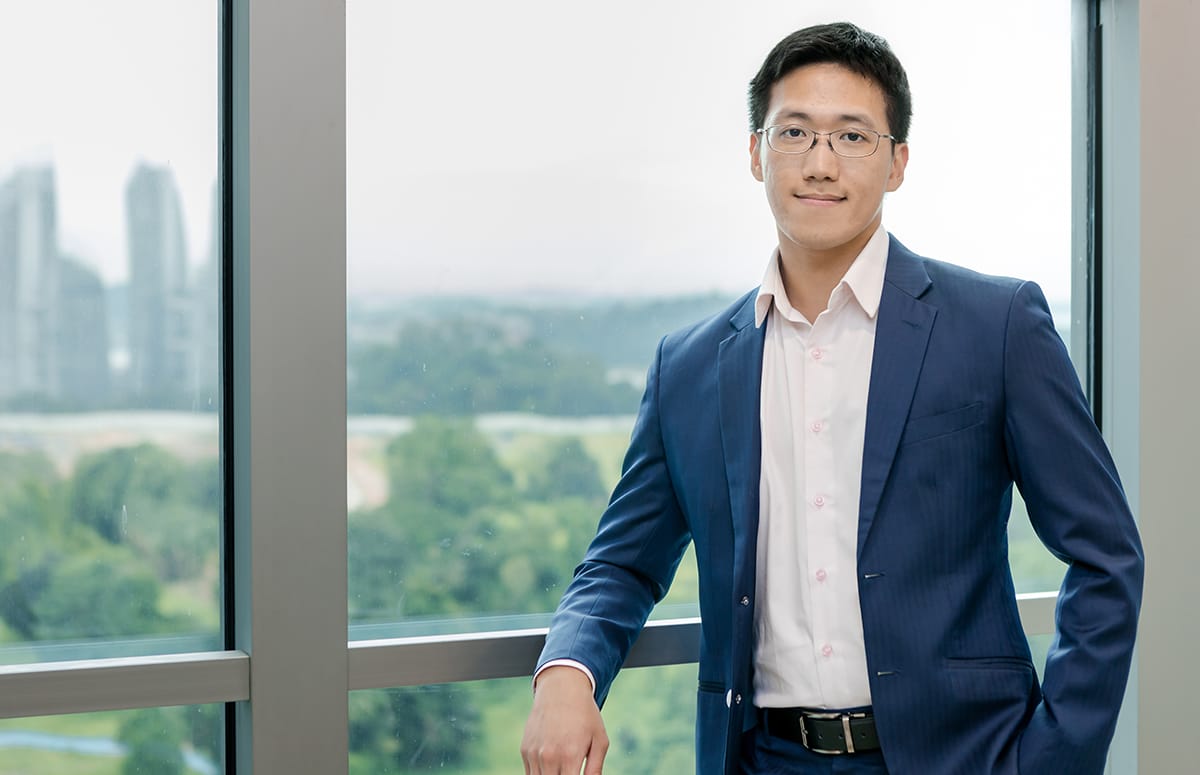
Jotham Teo
What keeps you motivated and excited each day?
What excites me most is the dynamic nature of the work. In a day, I could be working with government agencies on geospatial data adoption and handling public communications for MPA’s decarbonisation initiatives. The diverse and ever-evolving opportunities to drive meaningful change in Maritime Singapore are both motivating and deeply fulfilling.

GO-GETTER
Jotham is a true go-getter. He stays active by climbing and cycling, while also taking up sailing lessons, playing the piano, and improving his French!
Speaking of opportunities, what sort of career development opportunities have you received so far?
MPA provides structured rotations, mentorship, and hands-on experiences, all of which have provided opportunities for me to develop my technical and professional competencies. In 2023, as part of my Master’s in Environmental Policy at the Paris School of International Affairs, Sciences Po, I had the flexibility to complete two overseas internships. The first was with the Global Maritime Forum in Copenhagen, where I supported the Annual Summit on maritime decarbonisation, digitalisation, and human talent. The second was with the Trade and Logistics Branch of the United Nations Trade and Development, where I contributed to research and capacity-building efforts focused on sustainable and resilient freight transportation systems.
I am thankful for MPA’s support for my overseas studies and internships. These experiences have provided me with global exposure and deepened my understanding of the intersection of policy, technology, and sustainability—insights that continue to shape my work today. If you have the drive to innovate, collaborate, and make a difference, MPA provides the platform to do just that!