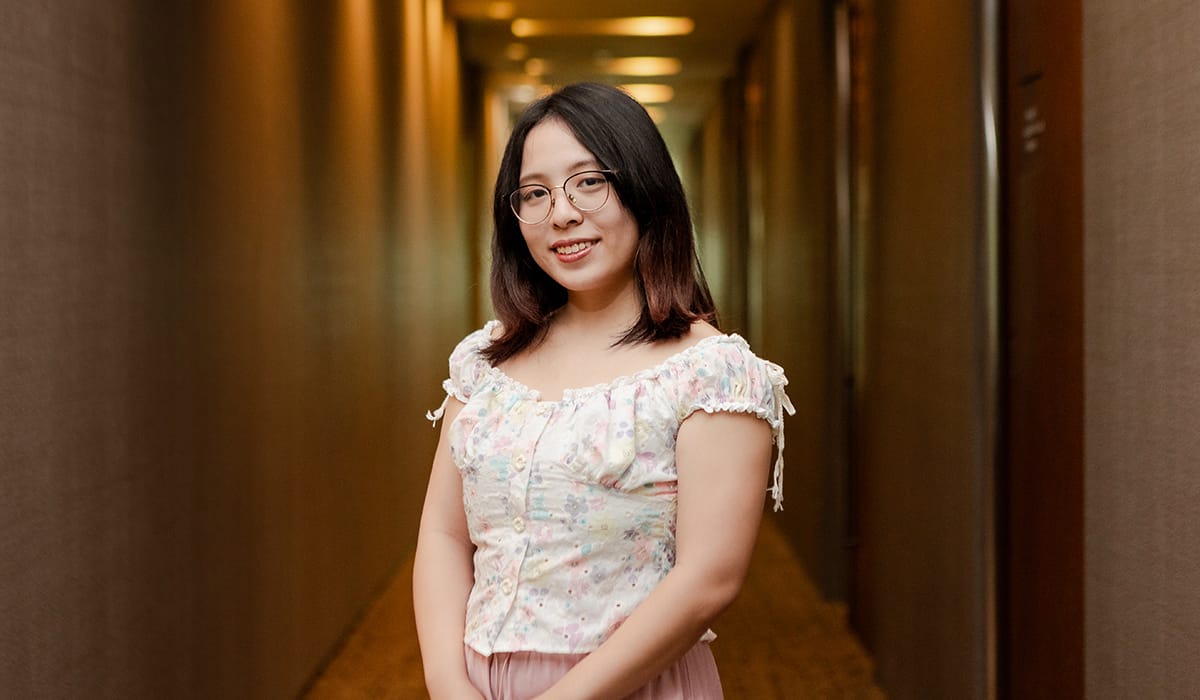
Shaine Goh Si Hui is a Manager, Infocomm Technology & Planning at the Inland Revenue Authority of Singapore (IRAS). She is a recipient of the IRAS Merit (Local) Undergraduate Scholarship and holds a Bachelor of Computing (Computer Science) with Honours (Distinction) from NUS.
For Shaine Goh Si Hui, a scholar with the Inland Revenue Authority of Singapore (IRAS), taxes are a gateway to drive meaningful change.
As a Manager at IRAS’ Infocomm Division, Shaine applies her computing skills to transform how tax services are delivered. Her passion lies in using technology to drive impactful solutions, ensuring that her work not only advances the field but also serves the public good.
We sat down with Shaine to learn more about her love for computing and how it has evolved into the impactful work she’s doing at IRAS today.
How did your interest in computing first come about?
I participated in a hackathon hosted by the School of Science and Technology in 2015, and that was my first real exposure to programming and problem-solving through technology. I really enjoyed the creative problem-solving aspect of programming and felt extremely fulfilled seeing a project I worked on come to life.
With a computing degree, you had a range of options in the tech industry. What drew you to pursue a career with IRAS specifically?
IRAS stands out from commercial tech companies as it allows me to create solutions that directly support Singapore’s tax administration and public services, imbuing my work with a deeper sense of purpose.
While many tech companies offer interesting technical challenges, IRAS provides the unique opportunity to apply my technical skills to work on large-scale systems that directly impact millions of Singaporeans.
IRAS is also remarkably progressive in its technology adoption. It actively embraces modern technologies like cloud computing, microservices architecture, and advanced analytics. This means I get to work with new tools and methodologies while contributing to meaningful public service—offering the best of both worlds in terms of technical growth and social impact.
How has the IRAS Merit (Local) Undergraduate Scholarship benefitted you?
The IRAS scholarship has connected me to people and places.
I was exposed to the organisation’s work culture during valuable internship experiences. Professionally, these experiences allowed me to build strong networks within the organisation even before starting full-time work. I have been fortunate to receive mentorship from both experienced IRAS colleagues and senior leaders, whose diverse perspectives and insights have been instrumental in shaping my career development.
The scholarship also brought me to places that broadened my global outlook. I went on an enriching overseas exchange to the University of Virginia, which made a big difference to me on a personal level. It also enabled me to pursue technical courses and earn certifications that have not only enhanced my capabilities but also encouraged continuous learning and growth.

Shaine Goh Si Hui
In simpler terms, could you tell us what your current role encompasses?
I design, develop and maintain digital solutions that are used daily. This involves understanding what our users need and turning these requirements into practical features. It’s satisfying to see how the code I write translates into systems that make a real difference in tax administration.
How have your studies prepared you for your current role at IRAS?
My computing degree provided me with the essential technical foundation for my current role as a software engineer at IRAS. Here, I work on developing the core logic for IRIN3—the third generation of our tax administration system, the Inland Revenue Interactive Network (IRIN). This system serves close to five million entities annually and underpins Singapore’s tax administration and revenue collection service.
My degree has equipped me with essential skills that I use daily—from writing efficient and maintainable code for complex systems to collaborating with developers and communicating technical concepts to business analysts. The hands-on project work during my studies gave me valuable experience in translating business needs into technical solutions and tackling large-scale system challenges, which has been crucial to my work on IRIN3.
Could you share a key project you’ve worked on that has had a meaningful impact on Singapore’s tax system?
Software solutions to simplify tax systems translate to practical benefits for businesses.
As a software engineer in the Goods and Services Tax (GST) Domain Team for the IRIN3 redevelopment project, I have been involved in modernising IRAS’s digital infrastructure to meet evolving taxpayer needs. What makes this project particularly innovative is our focus on leveraging modern technologies and architecture to enhance the efficiency of tax administration. In addition to smoother GST submissions, the changes have also brought about more accessible tax correspondences. This modernisation effort contributes to Singapore’s smart nation initiatives by making tax compliance more streamlined and user-friendly.
How has your work in tech influenced how you approach tasks outside of work?
As someone who loves travelling, my work in tech has shaped me to be more methodical in the way I plan my itinerary. Similarly to how we’d have to account for various scenarios when coding, such as handling edge cases in testing, I instinctively plan for the unexpected in my trips.
What has your journey at IRAS been like so far? Any highlights you’d like to share?
Through IRAS’s Management Associate programme, I have built meaningful relationships with colleagues across various departments. Even though we are all busy, we still meet for lunch weekly. These conversations have helped me understand IRAS beyond my immediate work—from how different divisions collaborate on tax policies to upcoming digital initiatives that will further enhance taxpayer services. These conversations help me see the bigger picture of how our different teams come together to serve Singapore’s tax needs.
Working in the Infocomm Division (INFOD) has been truly rewarding. The supportive environment—where seniors and peers willingly share their expertise—has made my learning journey smooth and meaningful. I especially enjoy the collaborative debugging and problem-solving sessions with my teammates.
The Inland Revenue Recreation Club’s diverse activities—from aerial yoga to bowling and spin classes—have provided additional opportunities to connect with colleagues across the organisation.
What advice would you give to students considering a scholarship with IRAS?
For those from computing backgrounds, you will find that IRAS is much more than just tax administration. We are at the forefront of digital transformation, leveraging modern technologies to revolutionise how tax services are delivered in Singapore.
As a developer in the GST Domain Team, I have experienced various exciting opportunities to work with modern technologies and architectures. This commitment to technological advancement means you’re always learning something new, whether it’s exploring emerging technologies or finding innovative solutions to complex challenges.