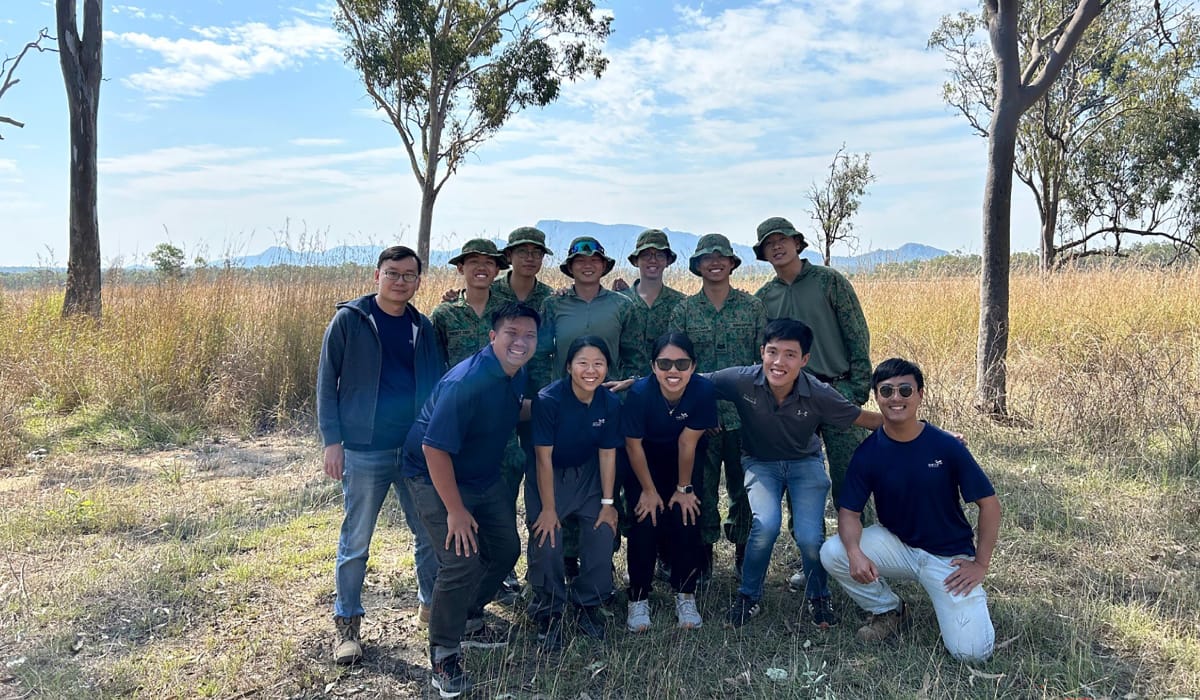
Clara Keng (bottom row, centre) is a Land Systems Engineer at the Defence Science and Technology Agency. She graduated from Stanford University with a Bachelor of Science in Electrical Engineering (Distinction) and is a recipient of the PSC Scholarship (Engineering) – Defence and Security.
Clara Keng has always been drawn to turning ideas into practical solutions. Her interest in engineering was first sparked by a project designing a miniature Formula 1 (F1) car for the F1 in Schools competition, and later through conducting materials science research under the Young Defence Scientists Programme (YDSP) at DSO National Laboratories.
“These experiences showed me the thrill of engineering as a means of problem-solving, and I was inspired to pursue engineering as a way to contribute to the community,” she shared. Beyond technical skills, Clara was equally curious about the policy considerations shaping technology, particularly in the defence sector.
This dual interest led her to the PSC (Engineering) Scholarship – Defence and Security, which offered hands-on exposure to both technical and policy-oriented postings within the Defence Technology Community.
The scholarship took her overseas to Stanford University, where she earned a Bachelor of Science in Electrical Engineering. It also opened doors to unique experiences, including a gap year with INTERPOL, which gave her exposure to international operations and broadened her perspective on how technology and policy intersect globally. “Working in an international organisation was a unique and rewarding start to my career,” she remarked.
Today, Clara is a Land Systems Engineer at the Defence Science and Technology Agency (DSTA), working in the Unmanned Ground Vehicles cluster. Her team manages robotic systems for Army operations, from quadrupedal “robot dogs” to fleets of drones. She acquires and develops technical systems that serve the SAF’s operational needs, and deploys them in real-world conditions.
One of her proudest projects involves multi-Unmanned Air Vehicle (UAV) systems, where multiple drones are coordinated centrally for intelligence, surveillance, and reconnaissance missions. “These systems allow the SAF to gather critical intelligence at lower risk to troops while easing the cognitive load on operators,” Clara explained. Her team often trials promising solutions ahead of clear operational needs, exploring new ways to apply technology effectively.
Beyond development, Clara supports large-scale events such as the National Day Parade and Exercise Wallaby, where systems are stress-tested in real-world scenarios. At NDP 2024, her team traced and resolved network connectivity issues while monitoring crowd flow — a moment that highlighted the tangible impact of her work. “Being part of these events gives me unique experiences I wouldn’t find anywhere else, and motivates me to keep improving,” she enthused.
Clara credits her growth to both DSTA and PSC programmes, which exposed her to diverse technical domains, collaborative projects, and a deeper understanding of Singapore’s defence ecosystem. “Through these projects, I’ve come to appreciate collaboration and the value each team member brings,” she reflected.
Looking ahead, Clara is excited to see her robotics projects in the hands of SAF users and enhance operational capabilities. She also values DSTA’s flexibility to explore new technical challenges or project management roles, allowing her to chart her own career path. “DSTA offers opportunities to deepen our expertise or explore new subjects, even beyond our current job scope,” she shared.
For aspiring engineers, her advice is simple: “Always stay curious and don’t be afraid to try something new. Oftentimes, getting your hands dirty experimenting with technology is the best way to learn!” That same curiosity, which once drove her to design miniature race cars, now fuels innovations that strengthen Singapore’s defence.