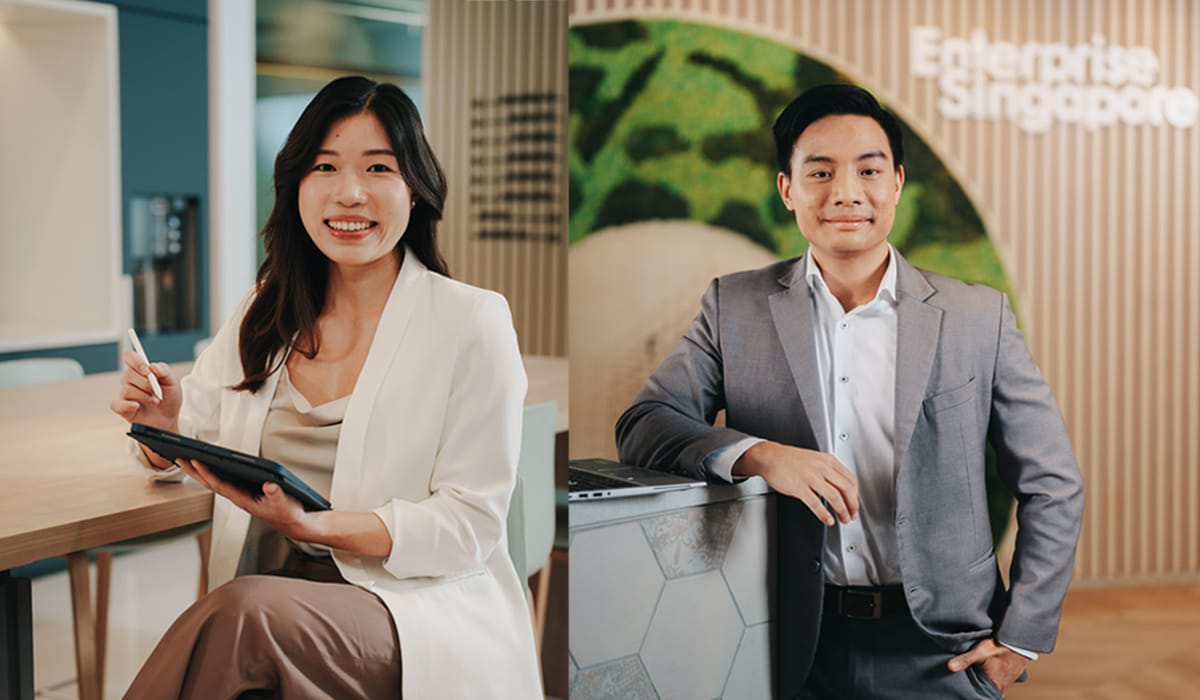
Left: Sarah Chiang is a Development Partner at Enterprise Singapore in the Urban Solutions and Sustainability division. She holds a Bachelor of Science in Cognitive Science from Yale University and is a recipient of the Global Executive Scholarship.
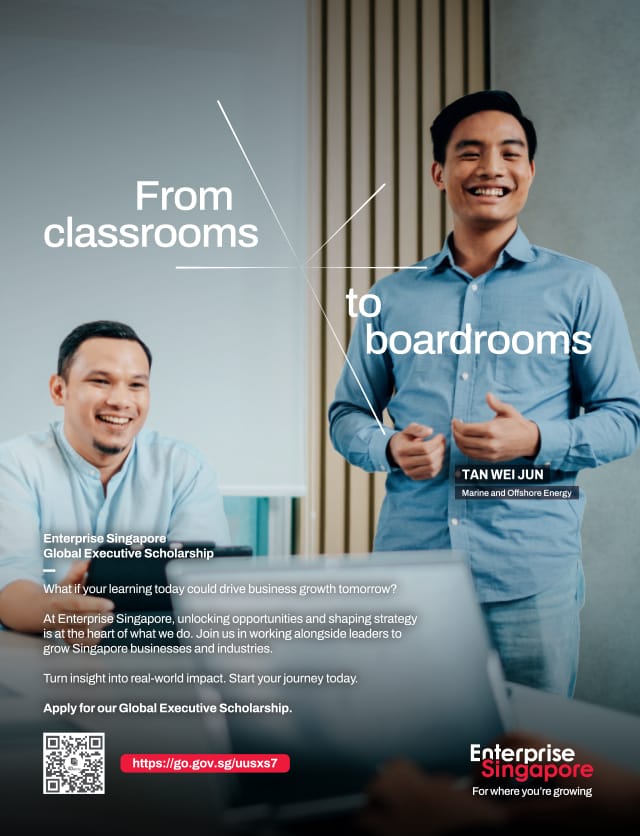
Right: Tan Wei Jun is a Development Partner at Enterprise Singapore in the Marine and Offshore division. He holds a Bachelor of Arts in History and Politics from the University of Oxford and is a recipient of the Global Executive Scholarship.
At Enterprise Singapore (EnterpriseSG), helping businesses grow goes beyond profits—it’s about shaping the future economy and creating good jobs for Singaporeans. As global trends such as sustainability and digitalisation redefine industries, the agency is at the forefront of helping local companies navigate them and expand globally.
This commitment to growth extends to its people. Through the Global Executive Scholarship (GES), EnterpriseSG nurtures young talent who aspire to make a difference, offering them invaluable exposure and opportunities to drive Singapore’s economic growth.
For Sarah Chiang, Development Partner in Urban Solutions and Sustainability, and Tan Wei Jun, Assistant Development Partner in Marine and Offshore, the GES has been a launchpad for impactful careers, empowering them to champion sustainable business growth and contribute to Singapore’s green economy. They share how their journeys at EnterpriseSG have shaped both their personal and professional growth.
Why did you choose the Global Executive Scholarship?
Sarah: I was drawn to EnterpriseSG’s unique focus on global exposure and the opportunity to contribute to Singapore’s economic growth by supporting local businesses.
In just a few years with EnterpriseSG, I’ve had the privilege of travelling to diverse markets such as Indonesia, China and the US, where engaging with industry leaders and diverse business ecosystems broadened my perspectives and provided fresh ideas. This aligns with my aspiration to stay curious and open-minded. I believe that embracing diverse ways of thinking and working helps me grow professionally and fuels continuous learning.
Wei Jun: For me, it was about the meaningful work and impact of EnterpriseSG. I’ve always wanted to work in the public service because I believe it offers the opportunity to contribute to the Singapore economy and enhance the livelihoods of Singaporeans.
EnterpriseSG stood out to me as an organisation where I could combine both policy development and practical execution. In our day-to-day work, we engage directly with businesses to understand their growth needs and challenges, and translate these into programmes that can make a real, tangible impact on the business landscape in Singapore.
Wei Jun, some might think that a business degree is essential for working with businesses. You chose a different degree—how has that impacted your role at EnterpriseSG?
I studied history and politics, which is far removed from business or economics at first glance. However, it offered me valuable insights into the history and evolution of international political and economic systems. For example, understanding why different markets have different regulations and attitudes towards trade. This understanding helps us support the growth of Singapore companies in overseas markets.
Sarah, what aspects of the scholarship experience have been most meaningful to you?
Beyond the opportunity to study at my dream university, what stood out most were the practical experiences that prepared me to contribute meaningfully to Singapore’s international interests. Being encouraged to pick up foreign languages, Korean and Bahasa Indonesia in my case, allowed me to better engage with key regional markets. This proved especially useful during my stint with the Indonesia Global Markets team, where I reviewed local news and policy papers in Bahasa to develop market entry guides for Singapore companies.
My internships were equally formative. With the Food Services team, I conducted research that informed companies’ pricing, marketing, and product innovation strategies, and supported the regional expansion of 20 companies. These experiences grounded my understanding of how Singapore companies grow beyond our borders.
That sounds like quite an experience! Can you give us a glimpse into your roles at EnterpriseSG?
Sarah: Within the Urban Solutions and Sustainability division, I focus on helping local companies and startups in the sustainable energy space innovate and grow. This primarily involves working closely with them to build capabilities, foster innovation and support their international expansion.
One of the most exciting aspects of my role is discovering and nurturing promising startups in the sustainable energy space, which is fast-paced and ever-evolving. It’s incredibly rewarding to be part of a sector that’s not only critical for Singapore’s future but also has the potential to shape global sustainability efforts.
Wei Jun: I’m part of the Marine and Offshore team, where I’m involved in driving the growth of the offshore wind sector. We work closely with companies to support them in developing the required capabilities in the global offshore wind sector. This involves developing autonomous marine robots, making sense of floating wind (which is a fascinating read!), or building all kinds of specialised vessels—both large and small—to support the construction of massive offshore wind farms around the world.
In a broader sense, it’s about helping Singapore companies lead in the green economy at a time when energy sustainability, affordability and security are taking centre stage.
Both of you focus on areas related to sustainable energy. How are you helping businesses tap into opportunities in this space?
Sarah: Clean, sustainable energy is crucial to our future. Global demand is growing, driven by the rise of AI, electric vehicles and other energyintensive technologies. Therefore, it’s important that EnterpriseSG works closely with companies in this sector, equipping them with the necessary capabilities to innovate, and capture new opportunities as they emerge.
One growth story I’m especially proud of is supporting a local solar company’s foray into the e-mobility space, from its first steps developing electric vehicle (EV) charging solutions to deploying high-powered fast chargers and expanding into Thailand and the Philippines.
Wei Jun: The shift towards sustainable energy also presents a commercial opportunity for businesses. We help Singapore companies capture such opportunities by connecting them to international markets like Germany, the UK, Japan, and South Korea.
For example, in partnership with the Association of Singapore Marine and Offshore Energy Industries, EnterpriseSG organised a national pavilion at Wind Energy Hamburg last September. We showcased the products and solutions from nine local companies, enabling them to secure partnerships with new clients internationally.
Venturing into an emerging sector can be daunting. What challenges have you faced and how have you overcome them?
Sarah: Going global isn’t easy—it takes a focused strategy to match what Singapore companies do well with what overseas markets need. That’s where our strong team culture at EnterpriseSG makes a difference. We work closely with our colleagues overseas to raise awareness of Singapore’s strengths and build local support, which helps smooth the way for businesses expanding internationally.
Wei Jun: Offshore wind isn’t something people usually associate with Singapore—we don’t even have offshore wind farms in our own waters! When we first talked to global stakeholders, we were often met with blank stares or lukewarm interest. It’s been a tough but rewarding journey. We’ve raised awareness of Singapore’s capabilities through thought leadership sessions, exhibitions, and forums. With EnterpriseSG’s strong support and resources, I’ve been able to grow my understanding of the sector, build networks, and represent Singapore globally. While we’re still early in the journey, I’m proud that we’ve started putting Singapore on the map of the offshore wind ecosystem!
How has your journey at EnterpriseSG shaped your growth, and how do you see your role evolving moving forward?
Sarah: My management associate experience has been especially valuable in helping me appreciate our diverse work across industries, markets and policy development.
In my current role, I get to work closely with business leaders, helping them grow by suggesting new ideas for innovation and market expansion. I’m excited to see some of these initiatives starting to bear fruit. On a larger scale, I’m leading industry-wide strategic reviews to uncover long-term opportunities in emerging sectors, helping to futureproof our economy and seed growth in the right areas.
Wei Jun: Leading my own workstreams and working with global stakeholders have honed my strategic thinking and stakeholder engagement skills. Taking ownership required me to think critically about how to shape meaningful programmes for companies and the sector, while balancing diverse perspectives and trade-offs. At the same time, collaborating with others to gain buy-in and drive execution has strengthened a core skill set, one that I will carry with me into any future role.
Finally, if you could describe Enterprise Singapore in three adjectives, what would they be and why?
Sarah: I’d say collaborative, forward-looking, and impactful. Collaboration is at the core of everything we do. We’re forward-looking, always assessing emerging sectors. Above all, our work is impactful, whether it’s helping a Singapore brand thrive abroad or launching a new product.
Wei Jun: Stretching and innovative. What we do is never static. And with innovation-related initiatives such as Innofest and Sustainnovation Ideathon, EnterpriseSG provides an environment where it’s okay to ask questions and challenge old processes and thinking.