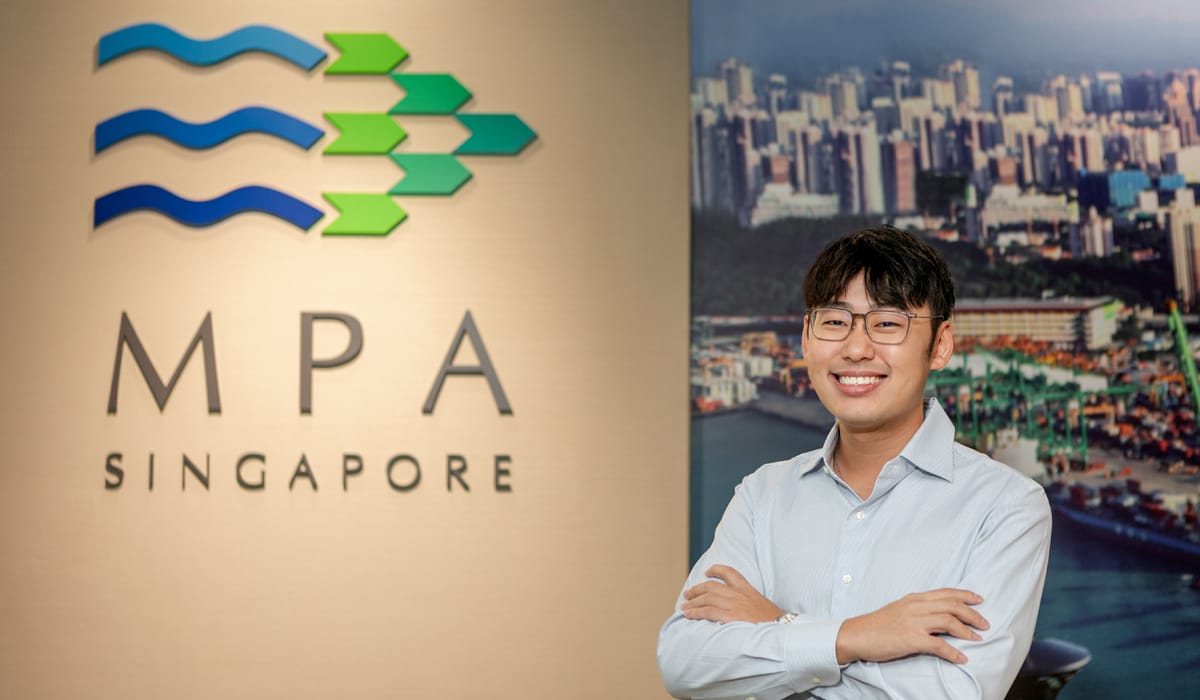
Lennon Chia
When you think of the maritime world, images of ships, ports, and bustling trade routes might come to mind. What you don’t see? The complex legal frameworks that keep every vessel moving safely and efficiently through Singapore’s waters.
For Lennon Chia, that unseen side of the industry has always held deep appeal. Guided by values of fairness and empathy instilled from a young age, he saw law as a means to turn his convictions into action. Today, as a Legal Counsel at the Maritime and Port Authority of Singapore (MPA), Lennon helps chart the legal course that keeps Singapore’s maritime hub resilient amid shifting global tides.
We spoke with him to explore his maritime law journey and the role he plays in steering Singapore’s ports.
Take us back to the beginning. How did you realise law was the path for you?
I chose law partly because I’ve never been great at maths, but that was only a small factor. More importantly, I’ve always loved how law sharpens the way you think. It teaches you to analyse and understand how people, society, and the world work, which makes it such an interesting and practical degree.
My mum has also been a big influence. Growing up, I was taught to look out for others and to stand up for what is right. We faced many challenges as a small family, which sometimes left me feeling powerless. Those experiences shaped my desire to study law — to empower others by giving them a voice when they might not be able to speak up for themselves.
There are many paths a law degree can lead to. What made you decide on the maritime sector?
Since young, I’ve learned how important maritime trade is to Singapore’s economy. I applied for the scholarship because I wanted to be part of an industry that’s truly the backbone of both Singapore’s economy and global trade. The more I learned, the more I realised how complex and fascinating the maritime world is — a dynamic ecosystem of systems and regulations that keep global trade running smoothly. With so many developments on the horizon, it feels like a great time to grow and contribute to this industry.
Why did the MPA Scholarship appeal to you, and how did it shape your university experience?
What stood out to me was that the MPA Scholarship supports law studies, something quite rare among public sector scholarships. It also offered internships and networking opportunities, giving me first-hand insight into the organisation, as well as engagement sessions that helped me feel connected to MPA’s public service mission.
On a personal level, I had the opportunity to spend eight months studying law at the University of Manchester through an MPA-sponsored exchange programme. Beyond experiencing the United Kingdom’s rich common law heritage, it was also the perfect opportunity to explore Europe!
Can you describe a typical day in your role as Legal Counsel at MPA?
No two days are the same! Some days, I meet policy colleagues to discuss how to implement their ideas within the legal framework. Other days, I’m preparing for international meetings, handling incidents like oil spills or abandoned vessels, advising on regulatory issues, or reviewing legislation to keep up with industry changes. And of course, there’s the lighter side — laughter over lunch and light-hearted moments with colleagues. It’s a great balance between meaningful work and a genuinely supportive environment.
How do you apply your law school learning to maritime work, and what were the biggest challenges?
Studying maritime law gave me a solid grasp of the industry’s rules — from the unique strict liability and limitation of liability regimes to technical terms like bunkers, salvage, and port or starboard (left and right sides of a ship). It also deepened my understanding of how responsibility and risk are managed in this sector.
This foundation proved invaluable just two weeks into my first job, when I was involved in managing the Marine Honour oil spill in June 2024 — Singapore’s largest in a decade, with multi-million-dollar losses. It was a steep learning curve, but also an incredible opportunity to see how the law operates in practice and to be entrusted with meaningful responsibilities early in my career.
How do you stay updated in a constantly evolving maritime sector?
I’m very grateful that MPA has a strong culture of learning. The organisation offers a wide range of programmes, from sustainability workshops on the industry’s decarbonisation drive, to whole-of-government initiatives supporting Singapore’s net-zero goals. We also get opportunities to attend overseas workshops and seminars conducted by research institutes to better understand jurisdictional issues in the global maritime trade and the evolving international liability frameworks, especially with new developments such as green fuels and autonomous vessels. There are honestly so many opportunities — the real challenge is finding enough time for all of them! But the environment makes it easy to keep learning and stay on top of developments in such a fast-evolving sector.
If you could step into any role at MPA for a day, which would you choose and why?
I’d probably choose either the International Division or the International Maritime Centre Division. As they focus on external engagement, it’d be exciting to experience that mix of diplomacy and partnership work which helps strengthen Singapore’s position as a global maritime hub. I’d also love to see what the Shipping division does, since they drive Singapore’s status as one of the world’s leading and most trusted flag registries. And if I could, I’d even join the Port Inspectors for a day to see how they keep our port safe and secure. What I really appreciate is that at MPA, you don’t have to just imagine these experiences — the organisation actively encourages officers to explore different areas, making opportunities like this truly possible.
What career opportunities can scholars look forward to at MPA?
There are plenty! MPA is both a regulator and a promoter of Singapore’s maritime industry, so there’s something for every interest — whether it’s policy, legal work, international engagement, port operations, or industry development. For legal scholars especially, starting in the Legal division provides a strong analytical foundation that’s useful anywhere in MPA and even across government.
What’s one final piece of advice you’d give to aspiring lawyers considering maritime law?
Just do it! Maritime law is unique and rewarding, connecting you to Singapore’s proud maritime heritage. It brings together many areas of law — contract, tort, insurance, international law — and is both intellectually rigorous and practical. As my professor once said, “If you can do maritime law, you can do any kind of law,” and I couldn’t agree more!

Lennon Chia
MPA Scholar
Legal Counsel
Bachelor of Laws,
Second Class Honours (Upper), NUS