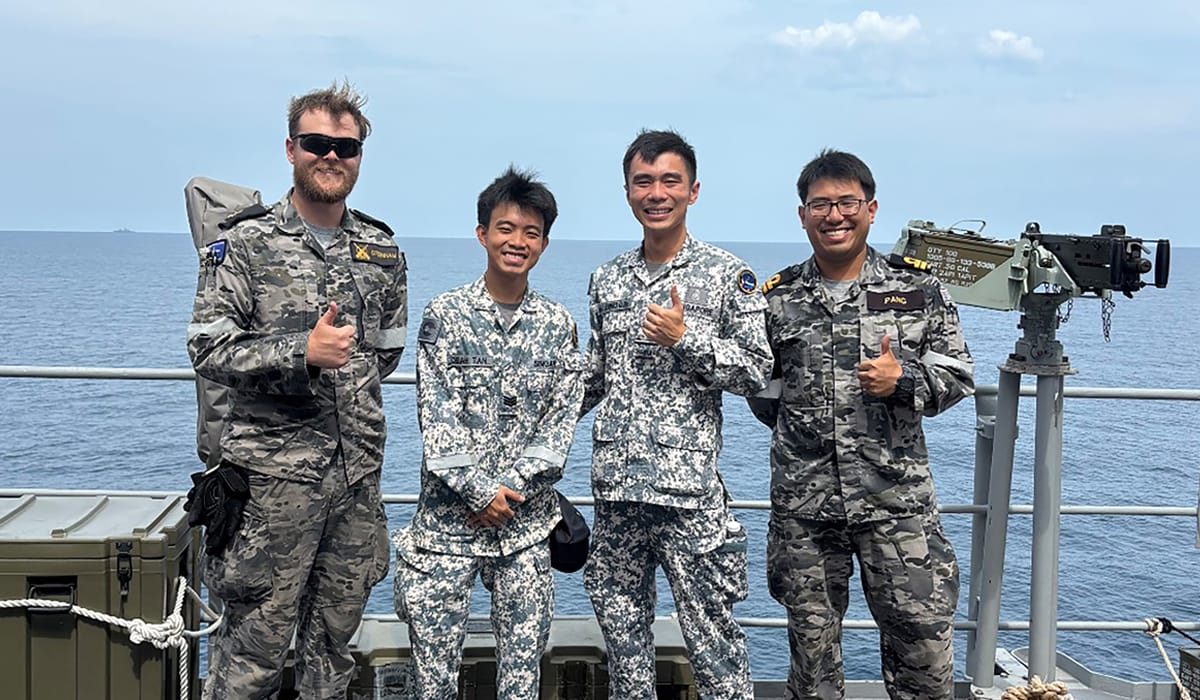
ME4 Edward Quah (second from right)
From a young age, Edward Quah thrived on challenges. Whether in school projects or personal pursuits, he gravitated towards environments that required him to think critically and constantly improve.
That mindset drew him to the Singapore Armed Forces (SAF), where careers are shaped by evolving responsibilities and real-world challenges. Within the SAF, the RSN stood out.
“Its warships are among the most complex engineering systems in the SAF,” he explained. “Knowing that my engineering decisions would directly affect ship safety, operational readiness, and the sailors who operate them ultimately inspired me to pursue a career with the RSN.”
First Lessons in Leadership and Responsibility
With a clear sense of purpose, Edward applied for the SAF Engineering Scholarship. It not only supported his studies but instilled a strong sense of accountability.
“The scholarship shaped how I approached my studies,” he reflected. “It motivated me to pursue a strong grasp of fundamentals, seek practical relevance in everything I learned, and hold myself to high standards — knowing that my future decisions would affect real systems and real operations.”
His field of study further sharpened his ability to break down complex systems, understand failure modes, and make evidence-based decisions, skills that are indispensable for a career in naval engineering.
Edward first put these skills into action at the Systems Readiness Engineering Centre (Network & Sensors), where he was responsible for keeping surveillance radar and Command & Control systems on Littoral Mission Vessels operationally ready at all times.
“I led a small team of seven engineers, where I was responsible not only for technical outcomes, but also for mentoring my team, prioritising tasks, and coordinating with multiple stakeholders to deliver engineering solutions that improved fleet-wide readiness,” he said.
It was in this role that he learned how engineering decisions ripple through operations — and how leadership, communication, and accountability matter as much as technical knowledge.
Engineering at the Heart of Operations
Today, Edward serves as Assistant Ship Engineer aboard RSS Formidable, maintaining engineering systems, coordinating maintenance, and addressing emerging issues while staying in constant contact with operations teams to keep the ship mission-ready.
A standout moment came in the weeks leading up to a major deployment. The ship’s combat systems departments worked intensively to ensure all systems we were fully operational, requiring meticulous planning, defect rectification, and close coordination across multiple departments.
“Seeing how thorough preparation, teamwork and engineering discipline translated directly into operational success was incredibly rewarding,” Edward shared proudly.
The experience reinforced lessons in readiness, teamwork, and collective responsibility — principles that continue to guide him.
Reflecting on Growth
Edward credits the RSN for shaping both his professional and personal growth. He has tackled demanding environments that call for accountability, adaptability, and sharp judgment. Professionally, he has mastered complex engineering systems, operational decision-making, and leadership at sea and ashore. Personally, he has grown in resilience, discipline, and confidence — all while learning the real impact of teamwork and ownership. “I have grown not just as an engineer, but as a leader who understands the responsibility that comes with supporting sailors and missions,” he reflected.
To the Next Port of Call
Looking ahead, Edward aims to become a Senior Combat System Engineer, overseeing system readiness, capability development, and the growth of his teams. He also aspires to contribute at the strategic level, shaping engineering policy and readiness planning across the RSN — all while remaining grounded in operational realities.
For students considering a similar path, Edward highlights the variety of roles in the RSN — from shipboard engineering to shore-based work in systems development, readiness management, and innovation. He noted that these experiences give officers and engineers broad exposure, build technical expertise and leadership skills, and are reinforced through continuous learning on the job and in advanced courses.
“If you enjoy learning, trying new things, and growing with every challenge, the RSN is a place where you can turn that mindset into a meaningful and fulfilling career,” he advised.
From mentoring sailors to solving complex engineering challenges as a team, Edward’s journey reflects a career built on responsibility, growth, and service. Aboard RSS Formidable, he continues to embrace every challenge, knowing that behind every successful mission lies engineering done right.

ME4 Edward Quah
SAF Engineering Scholar
Assistant Ship Engineer
BEng in Electronics and Electrical Engineering