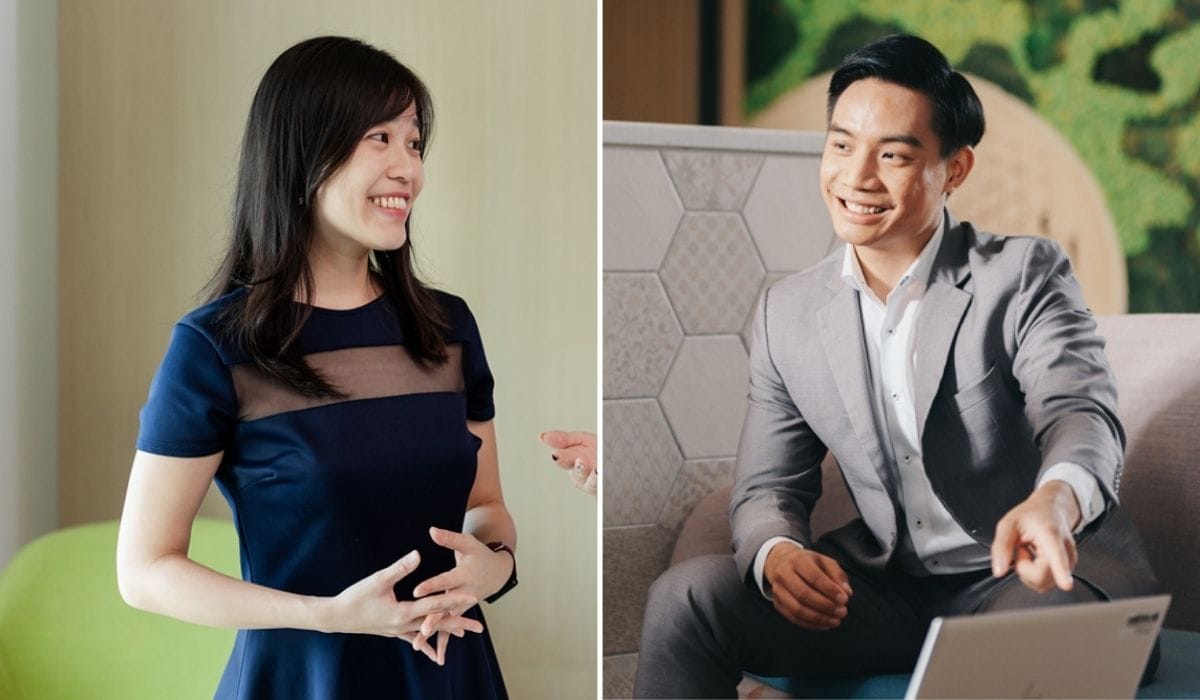
Michelle Tan and Tan Wei Jun
What begins as curiosity can spark a calling. For Michelle Tan, it was spotting Singapore-made products in an overseas mall. For Tan Wei Jun, it was the desire to strengthen Singapore’s economy through public service. Today, both Global Executive Scholarship recipients are building meaningful careers at Enterprise Singapore (EnterpriseSG).
From shaping sustainability programmes to uncovering new industry opportunities, they are helping businesses build capabilities, go international, and stay ahead of global shifts —collaborating across teams and with partners.
Find out what drew them to enterprise development, how the scholarship shaped their paths, and why their work continues to energise them.
What sparked your interest in enterprise development?
Michelle: It started during a family holiday when I came across Singapore-made products in an overseas mall and was struck with pride watching travellers rave about them. That simple moment sparked my interest in putting Singapore’s businesses on the global map. The EnterpriseSG scholarship gave me the opportunity to turn that curiosity into a career.
Wei Jun: I’ve always wanted to work in the public service, where I could contribute to Singapore’s economy and enhance livelihoods. EnterpriseSG stood out because it blends policy work with hands-on enterprise development. In our day-to-day work, we engage directly with businesses to understand their needs and translate them into programmes that make a tangible impact.
How did the scholarship shape your academic and professional journey?
Michelle: It opened doors to study in London and New York, two global cities rich in diversity and ideas. The exposure strengthened my ability to work with colleagues from across the world and shape economic strategies with a global perspective.
Wei Jun: The scholarship gave me the chance to study overseas, which opened my eyes to diverse cultures and perspectives and enriched my understanding of global issues. Singapore is a small yet influential player globally, and the exposure helped me evaluate policy decisions and trade-offs from a broader perspective.
The scholarship also enabled me to pursue foreign language training. I chose French, which has proven invaluable when engaging partners in markets such as France, Belgium and Africa.
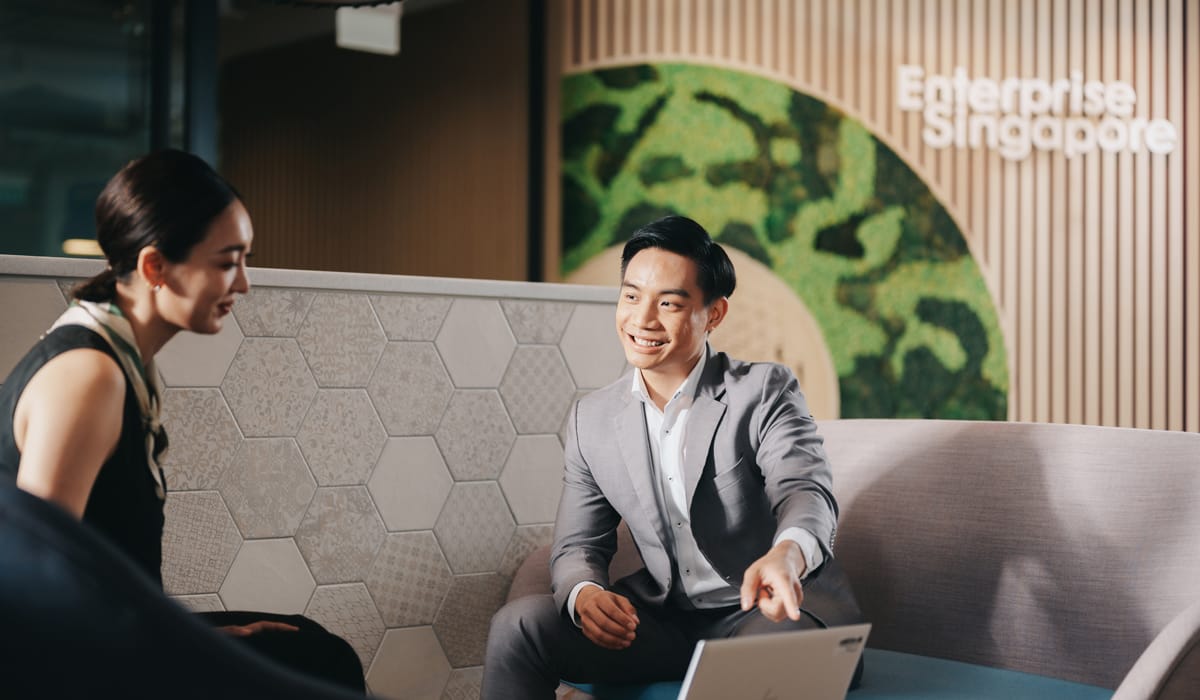
Tan Wei Jun
Can you walk us through your career journey at EnterpriseSG?
Michelle: Since joining in 2016, my career has been dynamic and rewarding. Across roles in the Markets and Industry groups, I had the chance to tackle something new daily, from bringing Singapore firms to explore opportunities in Batam to working with agencies on the Sea Transport Industry Transformation Map. I even picked up Bahasa Indonesia to better facilitate government-to-government collaborations.
These experiences paved the way for my two-year secondment to the Ministry of Trade and Industry (MTI), where I worked on fiscal resource management and Singapore’s economic response to Base Erosion Profit Shifting (BEPS) 2.0. Today, I lead a team helping businesses embark on sustainability through our programmes and initiatives. With rising expectations for transparency and decarbonisation, it’s been timely and meaningful to support companies in making this transition.
Wei Jun: I started with the nine-month Management Associate Programme in 2023, gaining exposure to both industry development and overseas markets. In the Marine and Offshore team, I engaged companies to understand challenges, contributed ground insights to policies, and helped organise an oil and gas and new energies business mission to West Africa.
My second rotation with the South Asia team broadened my perspective through deep dives into India’s semiconductor and quantum sectors to identify opportunities for Singapore companies. These experiences affirmed my passion for enterprise development, and I returned to the Marine and Offshore team to support the sector’s growth and transformation.
Michelle, how did your MTI secondment shape the way you approach work today?
It gave me much deeper insight into how policies are designed and how resources are allocated at the national level. I learnt to align operational interventions with broader economic goals and think more critically about policy decisions.
I also sharpened skills in process improvement and resource optimisation, streamlining interagency workflows and fostering collaboration. Most importantly, working in both a ministry and a statutory board helped me understand different stakeholder needs. I’m now better at connecting policy intent with ground realities, which helps me lead teams with clearer direction, greater empathy, and effectiveness.
What does a typical day look like in your current roles?
Michelle: I drive companies’ sustainability transformation by equipping them with actionable strategies for resource efficiency and long-term resilience. This involves meeting businesses to understand their needs, shaping policy positions, and designing solutions that improve their environmental impact and business performance. We also work closely with government and industry partners to help Singapore companies stay agile and globally competitive.
One meaningful example was developing the SME Sustainability Reporting Programme, which helps companies kickstart sustainability reporting in line with international standards.
Wei Jun: As part of the Marine and Offshore team, I’m involved in growing the offshore wind sector and positioning Singapore as a hub for the global offshore wind industry. We support companies in developing capabilities that the global industry needs, from autonomous marine robots to specialised vessels that support the construction of massive offshore wind farms around the world.
I collaborate with companies and colleagues across EnterpriseSG, and with agencies like JTC Corporation and the Energy Market Authority to create data-driven initiatives that enhance our global competitiveness. Site visits are also a regular part of the job to better understand company operations.
I also work closely with local firms and overseas partners, such as those in the UK and South Korea to map market needs and supply chain gaps. These insights guide targeted business missions and matchmaking opportunities that improve the likelihood of successful collaborations.
What excites you most about your role in driving Singapore companies forward?
Michelle: Helping Singapore companies advance their sustainability journey. As businesses face increasing pressure to meet environmental and societal expectations, implementing sustainable practices benefits both the planet and their long-term value. Supporting companies to develop resource-efficient, future-proof business models allows me to see tangible impact and contribute to a more sustainable, competitive business landscape for Singapore.
Wei Jun: Offshore wind isn’t something people usually associate with Singapore — we don’t even have offshore wind farms here! When we first spoke to global stakeholders about Singapore’s role, we were often met with blank stares or lukewarm interest. Over the past year and a half, we’ve raised awareness of Singapore’s capabilities through thought leadership sessions, exhibitions, and forums. With EnterpriseSG’s support, I’ve grown my understanding of the sector, built networks, and represented Singapore globally. While still early in the journey, I’m proud that we’re starting to put Singapore on the offshore wind ecosystem map.
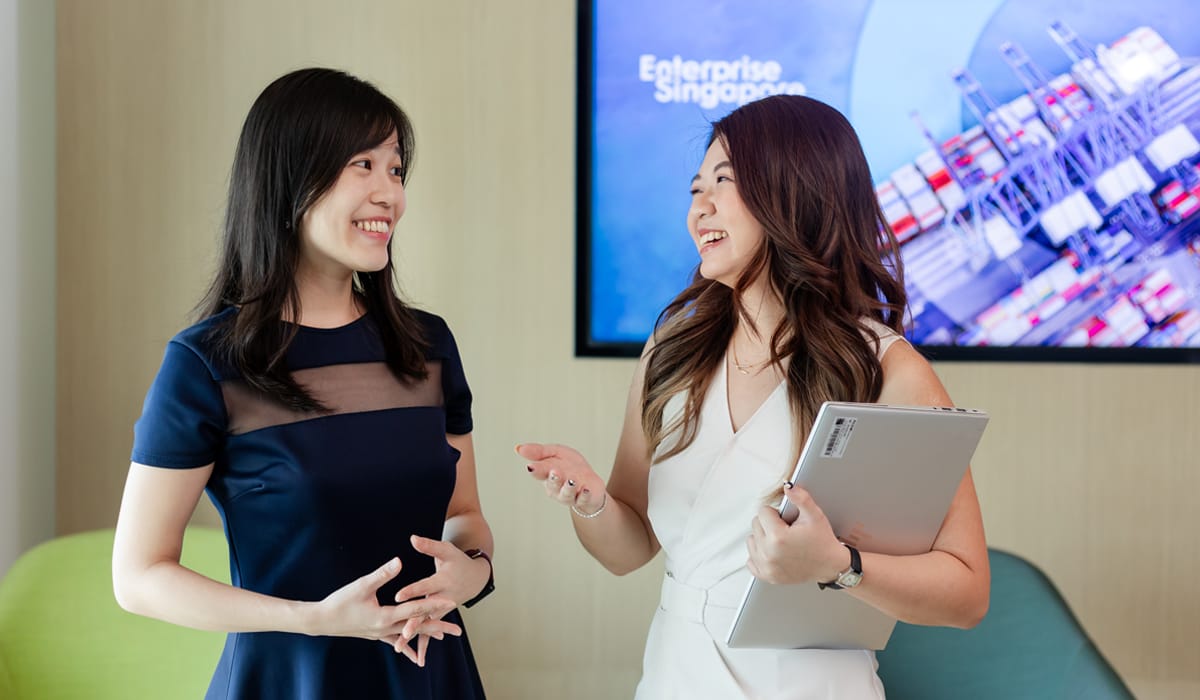
Michelle Tan (left)
Wei Jun, what career development opportunities have you experienced at EnterpriseSG?
EnterpriseSG has given me opportunities to take on meaningful work early in my career. For example, I led an initiative to strengthen innovation collaborations between Singapore and the UK in the floating offshore wind sector. This led to the launch of an offshore wind open innovation challenge track and a Memorandum of Understanding (MoU) between leading research institutes in both countries. Taking ownership of workstreams has sharpened my strategic thinking and stakeholder management skills.
I also appreciate the organisation’s strong focus on career development. Bosses regularly check in on long-term goals, offer guidance, and support my learning through courses like sustainable finance and account management.
Any words of advice for students considering this scholarship?
Michelle: Think about what excites you. If the prospect of growing Singapore’s economy, working with local enterprises, and the adventure of pursuing a global career excites you, a career with us will definitely be rewarding!
Wei Jun: I agree. If you enjoy working in a dynamic environment and driving new ideas, join us!
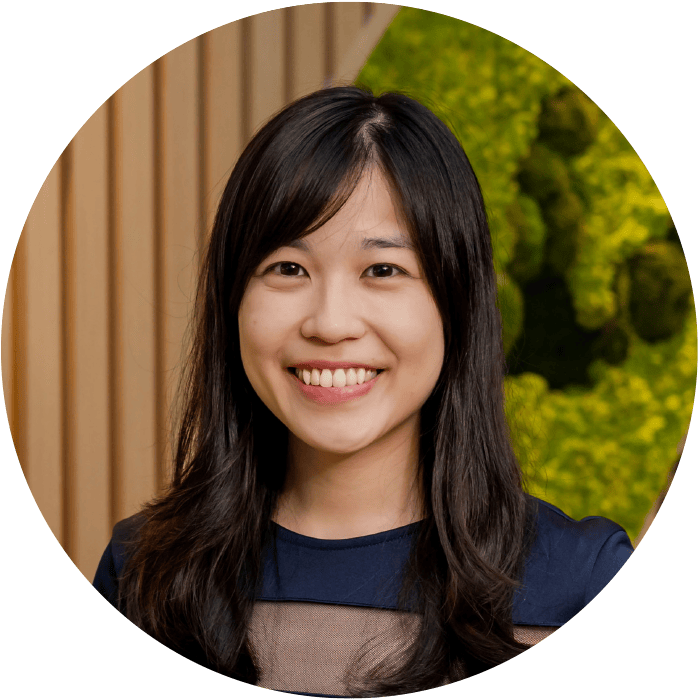
Michelle Tan
Deputy Director,
Enterprise Sustainability
MA in Political Science,
Columbia University
BSc in Economics
(First Class Honours),
University College London
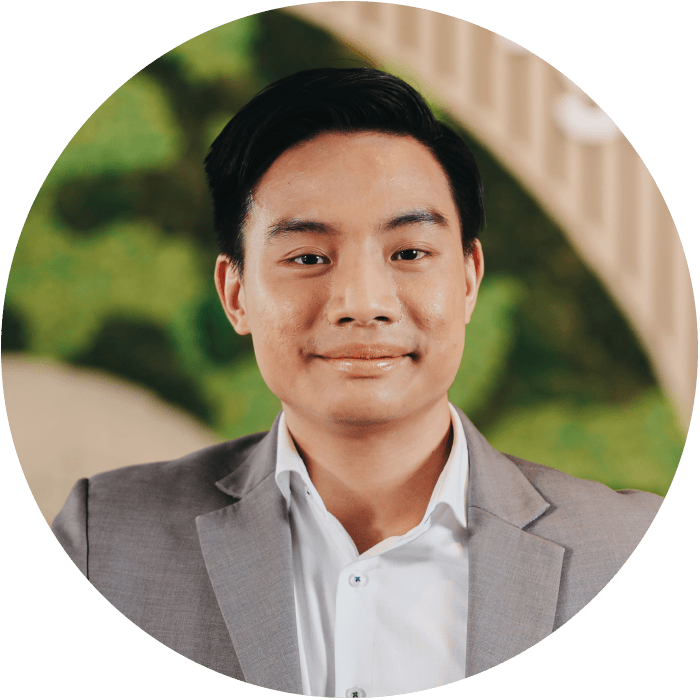
Tan Wei Jun
Development Partner,
Marine and Offshore Energy
BA in History and Politics,
University of Oxford