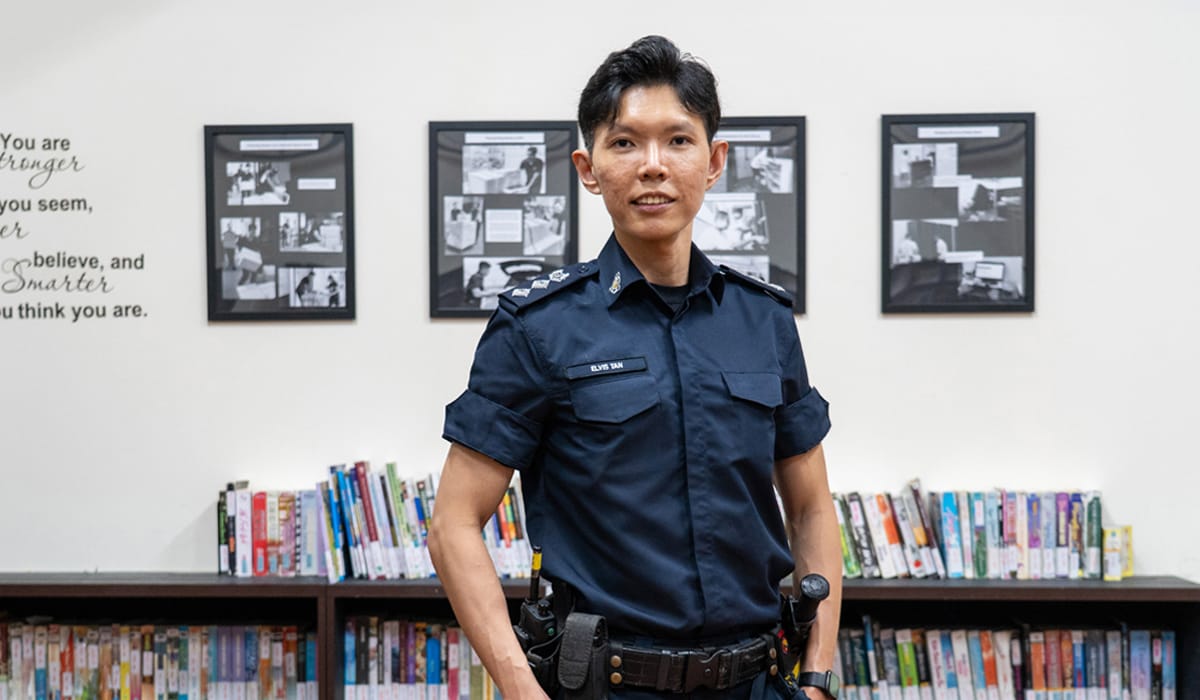
SUPT Elvis Tan
A career in corrections may not always be the first path that comes to mind, but for Elvis, it offered the chance to make a tangible difference by supporting offenders during incarceration and inspiring change.
As the Officer-in-Charge of a Correctional Unit at SPS, Elvis leads a team of 30 officers, also known as Captains of Lives. He engages directly with inmates, and works with partners on rehabilitation programmes. At Tanah Merah Prison, where he works with youth offenders in the Reformative Training Centre, he sees firsthand how early intervention can create lasting change. Drawing on psychological insights, he strives to understand individuals beyond their offences. His approach blends empathy and critical thinking honed during his studies.
We caught up with Elvis to discover what it takes to inspire change behind bars, and why this career offers meaning that few others can match.
What drew you to pursue a career in corrections at SPS?
It’s the meaning behind the work. In corrections, you are entrusted with the responsibility to enforce security and maintain order within prisons, while at the same time journeying with offenders through their incarceration. Through this balance of firmness and care, you have the opportunity to inspire hope, influence change, and contribute to their rehabilitation.
Having a uniformed background with the National Police Cadet Corps naturally drew me towards uniformed services. What truly appealed to me was the challenge of managing day-to-day operations that directly impact Singapore’s safety. It’s work that constantly demands clear thinking and sound judgement.
Why did you apply for the MHA Uniformed Scholarship, and what doors did it open?
The scholarship allowed me to pursue my genuine interest in psychology while gaining early exposure to prison work. I had the chance to complete my internship with the Singapore Prison Service, interact with prison officers and counsellors, and understand the role before officially starting. The scholarship also enabled me to go on a student exchange, which further broadened my perspective. It was the perfect blend of academic learning and hands-on experience in the field.
What got you interested in psychology, and how did your studies prepare you for your work today?
I’ll be honest, I aspired to read minds! But really, I’ve always been fascinated by humans. We’re like mystical “black boxes” — you can put two people in the exact same situation, and their responses can be completely different.
I pursued psychology to better understand how individuals think and behave. It’s helped me develop greater empathy for both staff and offenders. Understanding how their personal circumstances — from personality traits to childhood experiences — shape who they are today, and how they may evolve in the future is crucial in corrections work.
How has your journey with SPS evolved since you joined? What opportunities for professional growth have you gained?
It’s been an incredibly varied journey. Before being deployed to the ground, I went through the Senior Prison Officer Course, which equipped me with the knowledge and skills needed to lead effectively. I started my COL journey in a Correctional Unit, learning jailcraft, leadership skills, and decision-making on the frontlines. That foundation helped me understand practical challenges on the ground and the importance of sound judgement under pressure.
I later moved into staff postings in Prison Headquarters and the Ministry of Home Affairs, which demanded critical thinking, balancing competing priorities, and engaging various stakeholders. These experiences deepened my understanding of policy positions and intent, navigating red lines and even reading and amending legislation.
Alongside these roles, I’ve pursued professional development in coaching, which has transformed how I engage with both inmates and colleagues. There’s also a global dimension: I’ve had the privilege to participate in work trips and conferences with overseas counterparts from the United States, Australia, New Zealand, and beyond. Through these overseas engagements, I learnt from coaching and organisational development professionals about building a coaching culture, as well as gained insights into legislation and policies of different countries in law enforcement. Each phase of my journey has broadened my perspective and offered unique opportunities for professional development.
What does a typical day look like as Officer-in-Charge Correctional Unit?
Every day is different and that’s what keeps it interesting! Generally, my day involves attending meetings for strategic planning, coordination, and providing updates to stakeholders. I also make it a point to check in on my staff regularly because staff engagement is crucial.
Beyond that, I engage directly with inmates, clear their requests, and observe our processes and operations on the ground. A big part of the role is fine-tuning systems while staying connected to the people, officers and inmates alike. Maintaining a high level of operational readiness to handle any contingencies is crucial. Balancing operational demands, rehabilitation, and inspiring change makes the work both challenging and meaningful.
Leadership plays an important part in your role. How do you support and develop your officers while making sure operations stay on track?
I make it a point to check in with them regularly to ensure that they are seen and heard, reflecting SPS’s care culture of respect and support. Presence and genuine connections matter, as supporting their well-being empowers them to perform their roles effectively and make a meaningful impact.
I try to understand aspirations and align their work assignments accordingly, or craft a shared vision for the team. When people feel that their growth matters and they’re part of something meaningful, they naturally become more invested in both their development and the mission. That’s when operations naturally stay on track.
How do you and your team work with partners to help inmates prepare for reintegration into society?
We work with partners and stakeholders to conduct programmes within the facility. I’m particularly drawn to programmes with a strong throughcare component. For example, youth offenders who participate in basketball can continue the activity and stay connected to the community after their release. That continuity is crucial. It gives them something positive to anchor to, a community to belong to, and a constructive outlet as they reintegrate into society.
Can you share a moment that reminded you why your work at SPS is meaningful?
One incident that stood out for me was when an ex-offender approached me in the community. He recounted the disciplinary actions I had taken against him during his time in prison — and he thanked me for it.
That moment was profound. It reminded me that sometimes the hard conversations, the boundaries we set, the discipline we enforce can be turning points too. It’s not always about being liked in the moment; it’s about doing what’s right for their long-term growth.
There was also a youth offender who had a bad disciplinary record in prison. Through consistent engagement from staff and his own self-reflection, he genuinely turned a corner. Even his mother noticed real, positive changes in him. Moments like these are what make the work truly worthwhile.
What advice would you give to students interested in pursuing a career or scholarship in corrections?
SPS is a place where your work can have real meaning. It’s challenging, yes, but deeply rewarding.
If you’re interested, consider applying for an internship programme. Experiencing the work firsthand and hearing directly from staff about their experiences will give you a clear sense of what it’s like to journey alongside offenders. When the work resonates with you and you see the impact you can make — on individuals and on society — it becomes more than a career; it becomes a calling.
SUPT Elvis Tan
MHA Uniformed Scholar (SPS)
Officer-in-Charge,
Correctional Unit (Institution TM1)
MSocSci in Psychology, NUS
BSocSci (Hons – Highest Distinction), NUS