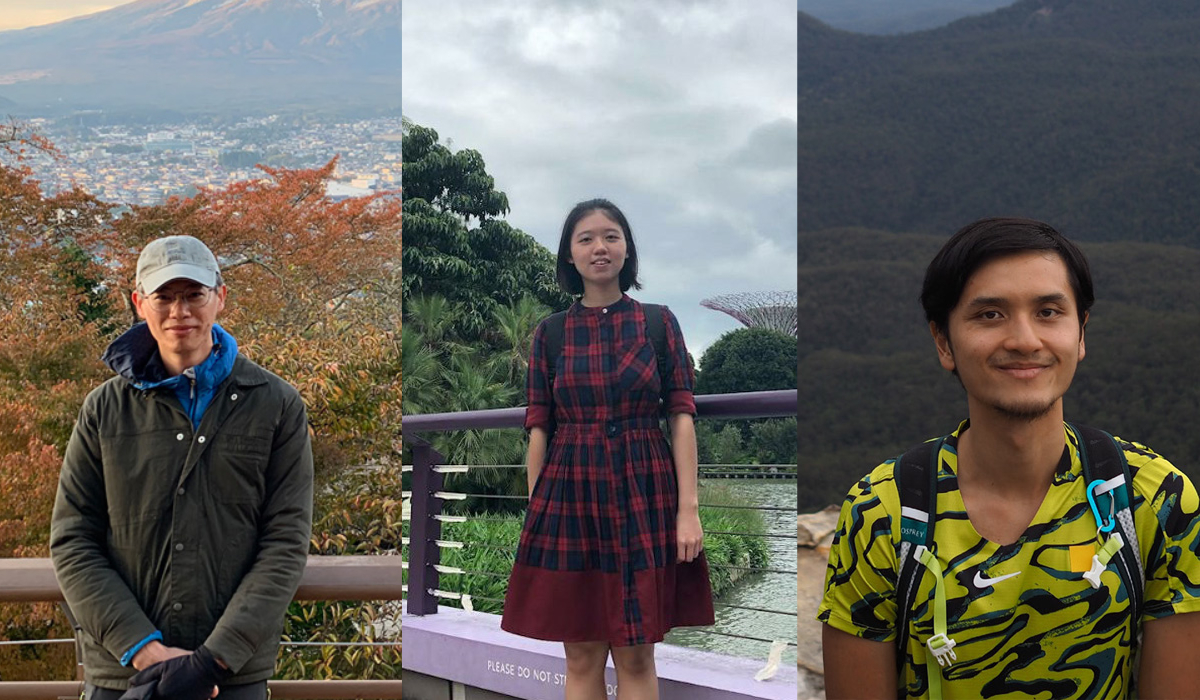
Left: Lan Yi Chieh is a Scientist at the Singapore Food Agency. He is a recipient of the Singapore Sustainability Scholarship and has a Master of Science in Agricultural Science from the University of Tokyo in Japan.
Middle: Lau Su Jun was awarded the Singapore Sustainability Scholarship and holds a Bachelor of Engineering in Civil Engineering from NUS. Today, she works as an Engineer at PUB, Singapore’s National Agency.
Right: Lim Guan Jie Gerald earned a Master of Science in Physics from Imperial College London in the United Kingdom. He is a recipient of the Singapore Sustainability Scholarship and is currently an Executive Meteorologist at the National Environment Agency.
The Singapore Sustainability (SS) Scholarship is empowering passionate individuals to champion environmental stewardship and ensure the security of our food and water resources. A collaborative effort between the National Environment Agency (NEA), PUB (Singapore’s National Water Agency), and the Singapore Food Agency (SFA), this scholarship helps foster a new generation of leaders committed to advancing sustainability.
Scholars Lan Yi Chieh, Lau Su Jun, and Gerald Lim are dedicated to driving positive change in their respective roles at SFA, PUB, and NEA. We delve into their inspiring career journeys and the impactful work that they are doing to shape a more sustainable future for Singapore and beyond.
What drew you to your respective fields?
Yi Chieh: I grew up learning about environmental protection and climate change, which planted the seed of passion for sustainability. I believe that sustainability involves handing over the environment in a better state, with sufficient resources to the next generation without compromising on our current standard of living. During my undergraduate days, I travelled around Southeast Asia and observed first-hand that the energy-water nexus and food supply could be easily disrupted and, in some cases, hanging by a thread.
When the “30 by 30” vision was announced, I thought that shaping Singapore’s food production capabilities for the nascent high-tech agriculture sector would be an exciting endeavour. My master’s degree in agricultural sciences, which was supported by the Singapore Sustainability Scholarship, deepened my understanding of the challenges faced by the agricultural sector and reinforced my commitment to finding innovative solutions to enhance food production while conserving our natural resources.
Su Jun: As a student, my fascination with environmental issues and sustainable technologies ignited my passion for engineering. Exploring the intricacies of the science behind our physical environment inspired me to pursue a degree in civil engineering. Additionally, my father, who is a civil engineer himself, provided invaluable guidance and influence in my career choice.
My decision to apply for the Singapore Sustainability Scholarship stemmed from two primary factors. Firstly, I have always been drawn to the water industry and saw an opportunity to contribute to Singapore’s water resources by working at PUB. Secondly, my academic background in physical Geography during high school sparked my curiosity about the engineering of our water networks.
By accepting the scholarship, I received invaluable financial support for my pursuit of a degree in civil engineering. This foundational education allowed me to take on engineering positions at PUB, allowing me to actively contribute to the industry. Additionally, through various networking opportunities, I have gained valuable insights into the industry’s pressing issues and stayed updated on the latest technological advancements, enhancing my professional growth, and understanding of the field.
Gerald: My decision to pursue a career as a meteorologist was influenced by my interests in physics and mathematics, which were my favourite subjects in school. I was drawn to the technical aspects of these subjects and sought a career that would allow me to apply these skills in a practical and impactful manner. Additionally, I enjoy nature and hiking, where weather is a huge factor and being mindful of the conditions is crucial for ensuring a safe and enjoyable outdoor experience.
I participated in the SS internship at the Meteorological Service Singapore (MSS)back in 2013 and found the nature and domain of work suited my interests and strengths. It was also my first exposure to computational algorithms and programmatic thinking–topics which weren’t very prevalent in the educational paradigm back then. The scholarship has provided me with valuable opportunities for networking, mentorship, and professional development, shaping my trajectory towards contributing to Singapore’s sustainability initiatives.
Interesting! Tell us more about the work you do today.
Yi Chieh: As part of the Urban Food Solutions Division, I work with Institutes of Higher Learning to translate research into tools that can boost our local farms’ productivity and cost-effectiveness.
The job is not desk-bound, and no two days are alike. For instance, I could be at a farm collecting data to identify problem statements or implementing solutions on Monday, at a research facility, understanding about A.I. applications in farm control on Tuesday, and in the office designing research with findings that could benefit local industry on Wednesday. I work with other departments within SFA, across agencies, and with external organisations frequently.
Su Jun: I currently work in the hydraulic modelling unit within PUB’s Water Reclamation Network Department. In this role, my team oversees the hydraulic modelling system, aiding planners in analysing simulation results for sewer adequacy assessment and bottleneck identification. Additionally, we maintain Singapore’s sewerage network models, ensuring they are consistently updated with the latest development information. We conduct model calibration and validation against measured flow gauging data to refine the accuracy of our simulation results.
Gerald: At NEA, I’m part of the Technology Solutions Branch under the Forecast Applications Development Department at MSS. We undertake Research and Development (R&D) work that develop products to support weather forecasting and improve service delivery to our various stakeholders. A typical workday involves coding, researching, and discussing methodologies with my colleagues. Besides the hands-on work, I’m also involved in the development of several other products from a product-owner/manager role.
Gerald, what do you think your most significant achievement to date is?
I’m proud of my contribution to Singapore’s Third National Climate Change Study (V3), the findings of which were released in January this year. I worked on it while I was under the Climate Projections and Extremes branch at the Centre for Climate Research Singapore (CCRS). My main contributions involved leading the data processing effort for our own in-house regional climate model projections and building up and managing the analytics stack for my team. This project was a sizeable and unprecedented endeavour from CCRS and I’m proud of my colleagues for their efforts, resilience, and accomplishment.
Su Jun, tell us about how PUB has contributed to your professional development.
PUB places a strong emphasis on staff development, providing a variety of avenues for professional growth that have greatly contributed to my development. The organisation has established a dedicated department responsible for arranging training programmes tailored to the competencies required for each job position. This structured approach is supported by a comprehensive framework designed to empower employees to reach their full potential and encourage them to take ownership of their learning.
Under this framework, we are provided with opportunities to expand and deepen our skills through various training initiatives, including modules and courses offered by Institutes of Higher Learning, as well as certifications from professional bodies. These opportunities broaden our skills, deepen our expertise, and enable us to stay current with industry.
Finally, what opportunities are available for individuals with in SFA, Yi Chieh?
At SFA, there are diverse roles that leverage various skills and expertise from research and development to policy analysis, technology extension, and stakeholder engagement. We can contribute to research projects, collaborate with multidisciplinary teams, and participate in innovative initiatives aimed at enhancing agricultural productivity, sustainability, and resilience. Additionally, SFA provides opportunities for professional growth, networking, and continuous learning through training programmes, workshops, conferences, and mentorship opportunities.