Left: Tan Shao Wei is a recipient of the DSTA Scholarship and has a Master of Electrical & Electronics Engineering from University College London in the United Kingdom. He is a Senior Engineer with the Air Systems Programme Centre at DSTA.
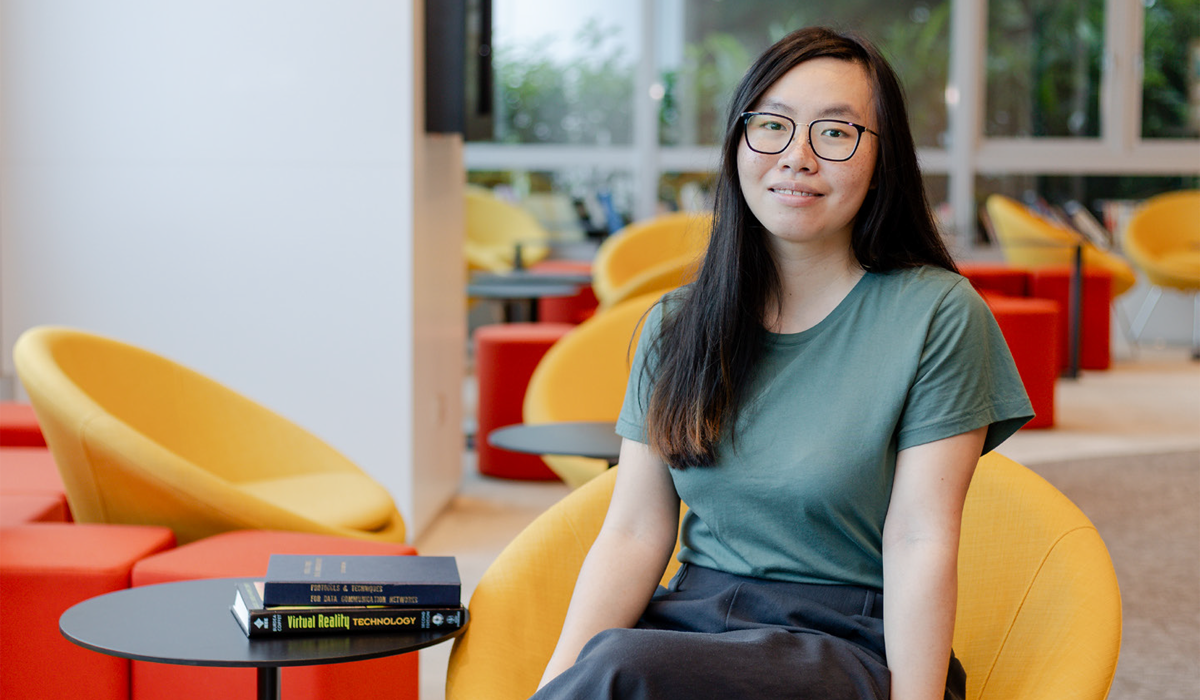
Middle: Pan You Qi Yuki has obtained a Bachelor and Master of Science in Natural Sciences from the University of Cambridge in the United Kingdom. She is a recipient of the DSTA Scholarship and is currently a Physicist at DSO National Laboratories.
Right: Teo Wei Zheng is a recipient of the DSTA Scholarship and is currently a Machine Learning Engineer at CSIT. He has a Master of Science in Computer Science from Columbia University in the United States and a Bachelor of Computing in Computer Science from the National University of Singapore.
Ensuring the strength of our nation’s security is paramount, as even the slightest vulnerability can pose significant risks. Hence, fortifying our defences across every front is essential. The DSTA Scholarship provides individuals with the opportunity to contribute to Singapore’s security, nurturing and empowering promising talent in the Defence Technology Community (DTC).
Recipients of the DSTA Scholarship Tan Shao Wei, Pan You Qi Yuki, and Teo Wei Zheng, are thrilled to be at the forefront of innovation and cutting-edge technology. In their integral roles at DSTA, DSO National Laboratories (DSO), and Centre for Strategic Infocomm Technologies (CSIT), respectively, they are dedicated to making meaningful contributions to Singapore’s defence landscape.
We had the opportunity to speak with them to gain insights into their work and the passion that drives them forward.

Tan Shao Wei
What motivated you to pursue careers in your respective fields?
Shao Wei: My interest in fighter jets and aircrafts started at a young age, sparked by attending various airshows where I had the opportunity to marvel at these incredible machines up close. In fact, if I could, I originally wanted to be a fighter pilot.
My interest in defence and aviation naturally led me to explore potential career paths and scholarships in these fields. When the opportunity arose to work with the Air Systems Programme Centre at DSTA, it was an easy decision to make!
Yuki: Since childhood, I’ve been intrigued by the workings of both natural and man-made phenomena, prompting me to question their underlying mechanisms. As I grew older, I started to wonder why these day-to-day phenomena behaved the way they did. It was then that I realised my passion for learning, understanding models and solving problems quantitively, guiding me towards a career in science and engineering.
In junior college, I started exploring physics beyond what was taught in school. I came across intriguing topics such as general relativity and quantum mechanics, which caught my attention, but I lacked the mathematical background to fully comprehend them. It was then that I decided to pursue a career in physics.
Wei Zheng: My fascination with Artificial Intelligence (AI) and Machine Learning stemmed from witnessing their advanced capabilities, particularly in areas like image recognition and game design. During my internship with CSIT, I delved into topic modelling, further honing my skills and solidifying my passion for the AI field.
I decided to pursue a career in Machine Learning Engineering, which allowed me to do end-to-end work in research, development and deployment of solutions. This role not only allows me to leverage my research skills but also provides opportunities for continuous growth in software engineering.
Pan You Qi Yuki
What made you apply for the DSTA Scholarship?
Shao Wei: What attracted me to the DSTA Scholarship was the meaningful work that DSTA does, where I can contribute to the defence of Singapore. This gives me a sense of purpose as my work involves defending our people and building our nation rather than making a profit.
In addition, the scholarship also provided me with the opportunity to study overseas, which helped to greatly widen my perspectives.
As part of the Global Internship Programme, I was also given the opportunity to intern at Thales Solutions Asia, where I worked on developing and researching Internet of Things (IoT) network solutions.
Although my internship was in the midst of Covid-19, I still had a fruitful experience expanding my knowledge and honing my skills. I learnt how to independently make decisions, search for solutions and adapt them to the project accordingly.
Wei Zheng: I applied for the DSTA Scholarship because of the diverse opportunities it offers across the DTC. This flexibility enabled me to explore different areas of Computer Science during my studies to discover what I am truly passionate about.
Additionally, the scholarship’s support for overseas opportunities like the Global Internship Programme, and sponsorship for exchange programmes and master’s degrees greatly appealed to me. These opportunities would have been difficult to access without the scholarship and are essential for broadening my academic and professional horizons.
Lastly, my participation in DTC programmes like the Young Defence Scientist Programme confirmed that the DTC’s work aligned with my interests and career aspirations.
Yuki, what forms of support did you receive through the scholarship?
The DSTA Scholarship sponsored my tuition and college fees for my undergraduate and master’s. We also received a monthly allowance for our day-to-day spending and accommodation. I had the opportunity to do an internship at my current lab during my undergraduate days, with the scholarship covering flights back to Singapore.
Throughout the pandemic, the DSTA Scholarship Office took care of us by sponsoring Stay-Home-Notice fees and arranging last-minute flights back to Singapore.
They also regularly checked in to ensure our well-being.
Could you elaborate on your roles at your organisations?
Shao Wei: In my current role within the Air Systems Programme Centre, I serve as an engineer responsible for overseeing the airworthiness and aircraft-system integration aspects of my project.
A typical workday consists of reviewing design documents and helping to build an assessment of the overall airworthiness of the system. This includes liaising with stakeholders to ensure that various safety and design considerations are accounted for, and all parties are aligned on the approach based on the assessment provided by my team.
Yuki: As a research scientist working in the Applied Physical Sciences Lab, my primary role is to plan and execute experiments utilising physics concepts for defence applications. I am involved in approximately four projects, and my personal preference is to work with one at a given time.
My daily tasks vary depending on the project’s timeline and my role within it. At the beginning of projects, I tend to read relevant research papers. As the project progresses, my focus shifts to conducting simulations and assembling optical setups in the lab to support our objectives.
Wei Zheng: My team focuses on implementing evaluation-driven development (EDD) in our AI-powered products. EDD provides an overview of product performance, which enables us to assess the impact of changes on product quality. My work specifically deals with large language models (LLMs), where I design metrics to measure the quality of LLM responses and integrate these metrics into the observability stack.
CSIT places large emphasis on training.Beyond the initial training, I have also attended courses to further hone my skills in software engineering. I recently obtained my Certified Kubernetes Application Developer certification, equipping me with the skills to design, build and deploy cloud-native applications for Kubernetes.

Teo Wei Zheng
What is the most rewarding aspect of your job, Shao Wei?
The most rewarding part of the job is when we finally see the system we worked on up close and come to life from all the technical and design documents.
This helps to put things in perspective, showing that my work contributes to delivering a real and capable system for our Air Force. It gives me a sense of pride and accomplishment when we move towards the final goal of seeing our system delivered!
Additionally, I am very thankful for the great mentorship I have received thus far at DSTA. My mentors have helped to point out areas of exploration or improvement in my work. The learning curve can be steep, but I am thankful for the biannual chats with my mentors which have helped me ease into my role.
Yuki, any advice for individuals aspiring to follow a similar career path?
Over the years, I’ve observed many students entering university with the goal of becoming theoretical physicists. However, they would often find themselves drawn towards experiments and computational physics, exploring niches they hadn’t previously considered. My advice is to keep an open mind and pursue courses or join labs that interest you, rather than those you think are directly relevant to your future career. Technologies evolve at a rapid pace, and what you perceive as relevant today might become obsolete tomorrow.
Wei Zheng, what would you regard as your most significant professional accomplishment?
I would say it is writing a quantum computing paper in collaboration with external stakeholders to articulate the technology and its importance. Although not part of my official job scope, this paper has had a far-reaching impact. It has since been adopted by different departments across the Ministry of Defence and is now being developed for government-wide publication, with contributions from various ministries and agencies.