Left: Melissa Keong is a Psychologist with Rainbow Centre. She graduated with a Master of Arts (Applied Psychology) (Educational Psychology) from the National Institute of Education in Singapore and is a recipient of the Social Service Scholarship.
Right: Siti Nameera Zahara Bte Johan is a recipient of the Social Service Scholarship. She graduated with a Bachelor of Science in Occupational Therapy with Honours from the University of Liverpool in the United Kingdom. She is currently an Occupational Therapist at SPD.
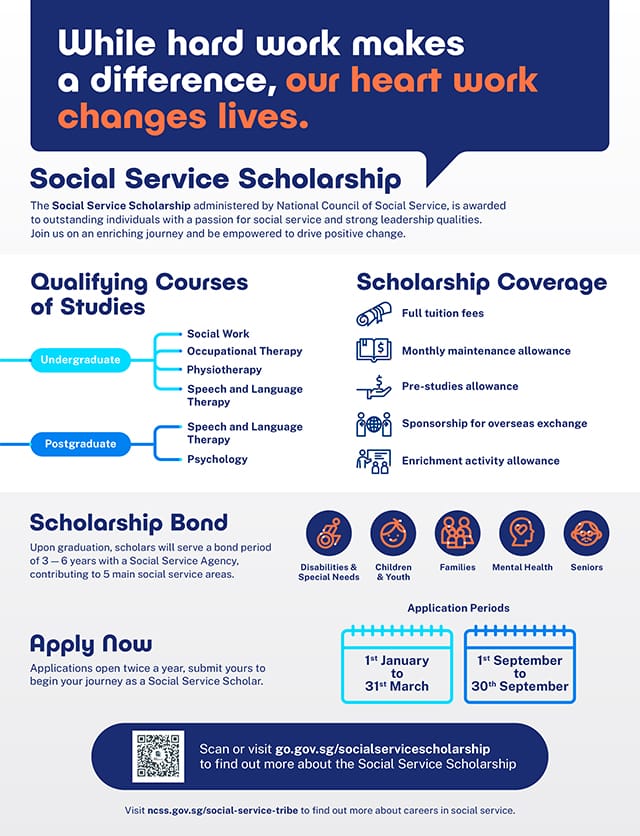
As recipients of the Social Service Scholarship by the National Council of Social Service (NCSS), Siti Nameera Zahara Bte Johan and Melissa Keong are outstanding individuals, who display a deep passion for social service. The prestigious award provides valuable opportunities for them to embark on transformative journeys, impacting not only on their own lives but also the lives of others.
Siti Nameera is an Occupational Therapist with SPD, which is an organisation that serves persons of all ages with disabilities or who may develop disabling conditions. She graduated with a Bachelor of Science in Occupational Therapy with Honours from the University of Liverpool in the United Kingdom.
Melissa is a Psychologist with Rainbow Centre. She graduated with a Master of Arts (Applied Psychology) (Educational Psychology) from the National Institute of Education in Singapore.
Read on to delve into their transformative journeys and discover what makes them champions of social service in our community.
Let’s go back to the very beginning, what was the impetus for your decision to pursue a career in your respective fields?
Siti Nameera: During my time as an early intervention teacher, I had the opportunity to work alongside a multi-disciplinary team. It was during these discussions that I recognised the importance of being a team member, who could provide practical and meaningful solutions to support issues faced day-to-day. That was when I researched more into the role of an Occupational Therapist and found the profession’s goal of advocating for well-being through engagement resonated with me.
Melissa: Growing up, there have been personal experiences that repeatedly brought the challenges of mental health to the forefront. They showed how big an impact it could have, and how the ‘invisibility’ of it made such situations even harder to manage. The accumulation of such experiences continued to nudge my aspirations towards a career in psychology. My internships throughout my undergraduate days and my very first job as a fresh graduate further cemented that decision, and I have not looked back since.
Could you share about your current role and responsibilities?
Siti Nameera: As an Occupational Therapist under SPD Therapy Hub, I am deployed to support two programmes — the Day Activity Centre (DAC) and the Enabling Services Hub (ESH). I support my clients’ participation in activities of daily living, social and recreational activities, including pre-vocational training. I work alongside an interdisciplinary team to provide holistic and person-centred care for my clients and their caregivers. Specifically, I conduct initial assessments for new clients, provide clinical knowledge on improving occupational performance problems and work with the other team members to provide holistic and person-centred care for my clients and their caregivers.
A typical day in the DAC includes conducting wheelchair assessments, providing consultation to training officers on managing group activities, and carrying out interventions to address occupational performance needs.
Conversely, in the ESH I will be out and about in the community with the clients where we could be volunteering at a library or enjoying a friendly game of bowling. I also conduct disability awareness talks with different stakeholders in the community and liaise with various vendors to provide them with clinical knowledge in adapting their activities to be more inclusive for our clients.
Melissa: My core work includes providing assessment and intervention services to children in my capacity as an Educational Psychologist. I conduct standardised psychological assessments with graduating students to understand their different profiles, which in turn facilitate their placements in different post-18 agencies. Standardised and informal assessments are also used with the rest of the school population to help me understand the areas of support they require and monitor their progress over time.
A big part of my work also includes conducting intervention sessions for students ranging from 7 to 18 years old, who have moderate to severe Autism Spectrum Disorde (ASD), multiple disabilities, and/or other neurodevelopmental conditions. The interventions typically focus on equipping students with socioemotional or leisure engagement skills, while also working on addressing challenging behaviours when necessary.
How has the scholarship meaningfully impacted your career?
Siti Nameera: The scholarship was an important element in my journey as an Occupational Therapist as I was able to study at a recognised university and gain invaluable learning experience in both classrooms and clinical placements.
Being awarded the Social Service Scholarship meant that I was also given opportunities for further training and career support. With the guidance of my NCSS officer, I was able to schedule job interviews before graduation. This meant that I could seamlessly transit into my new job after completing my studies and feel supportedas I navigate my new career as an Occupational Therapist.
Melissa: The experience in both my undergraduate and postgraduate course work definitely helped with providing some much-needed foundation for understanding psychological concepts. These concepts still continue to inform the strategies that are developed and the decisions that are made. For example, theories on understanding behaviour and the concepts behind behavioural strategies are frequently used to shape the intervention plans in my current role. The foundational knowledge of developmental milestones also helps in identifying areas of concern when conducting assessments.
Conducting research for my dissertations has also fostered my interest in conducting studies to inform our clinical work. In my current role as a Psychologist in Rainbow Centre, I have the opportunity to propose and run a study that looks at evaluating alternative interventions for anxiety management in my current client population.
Beyond the expected benefits of the theoretical knowledge gained throughout those years, the internships and practicum attachments have arguably played an even bigger part in preparing me for my current role. These experiences provided numerous opportunities to learn more soft skills.
On a lighter note, name one thing people might not know about you and/or your job.
Siti Nameera: Nothing measures up more than having my trusty measuring tape with me. This is so I can easily take measurements of my clients for an assistive device or understand the physical layout of my client’s environment so that I can suggest suitable modifications.
Melissa: After being a proponent of having effective self-regulation skills for many months, I finally heeded my own advice and now have a big grey soft toy elephant sitting on my office chair. It serves as a source of comfort, and hugging it serves as a means to decompress when the need arises. It also serves a side benefit of improving my posture when I work at my desk!
Any advice for our readers of similar career pathways, or aspirations?
Siti Nameera: Explore a hobby of your own and set aside time to spend time participating in it. You may not always stick to the same hobby, or may even have multiple hobbies, but surely, they will give you a sense of respite from the challenges that work may bring and let you have a deeper appreciation for the impact of leisure on one’s well-being. I believe that having hobbies makes you a better Occupational Therapist!
Melissa: Always find opportunities to gain as much hands-on experience as possible. This could come in the form of job shadowing with other professionals in the field or even interacting with different client populations in different capacities. Having a variety of such first-hand experiences would be a good way to understand if a job or a profession would be a good fit for you.
In short, to anyone who is considering a similar path, I would say to take as many leaps of faith as you can and seize all the opportunities available to make as informed a decision as you can. It may also help to know that it is okay if some choices do not work out at first, as it is a long and constantly evolving journey to discover what suits you best.